
From “It Worked Once” to “It Works Every Time” (Mandate 2: Reproducible)
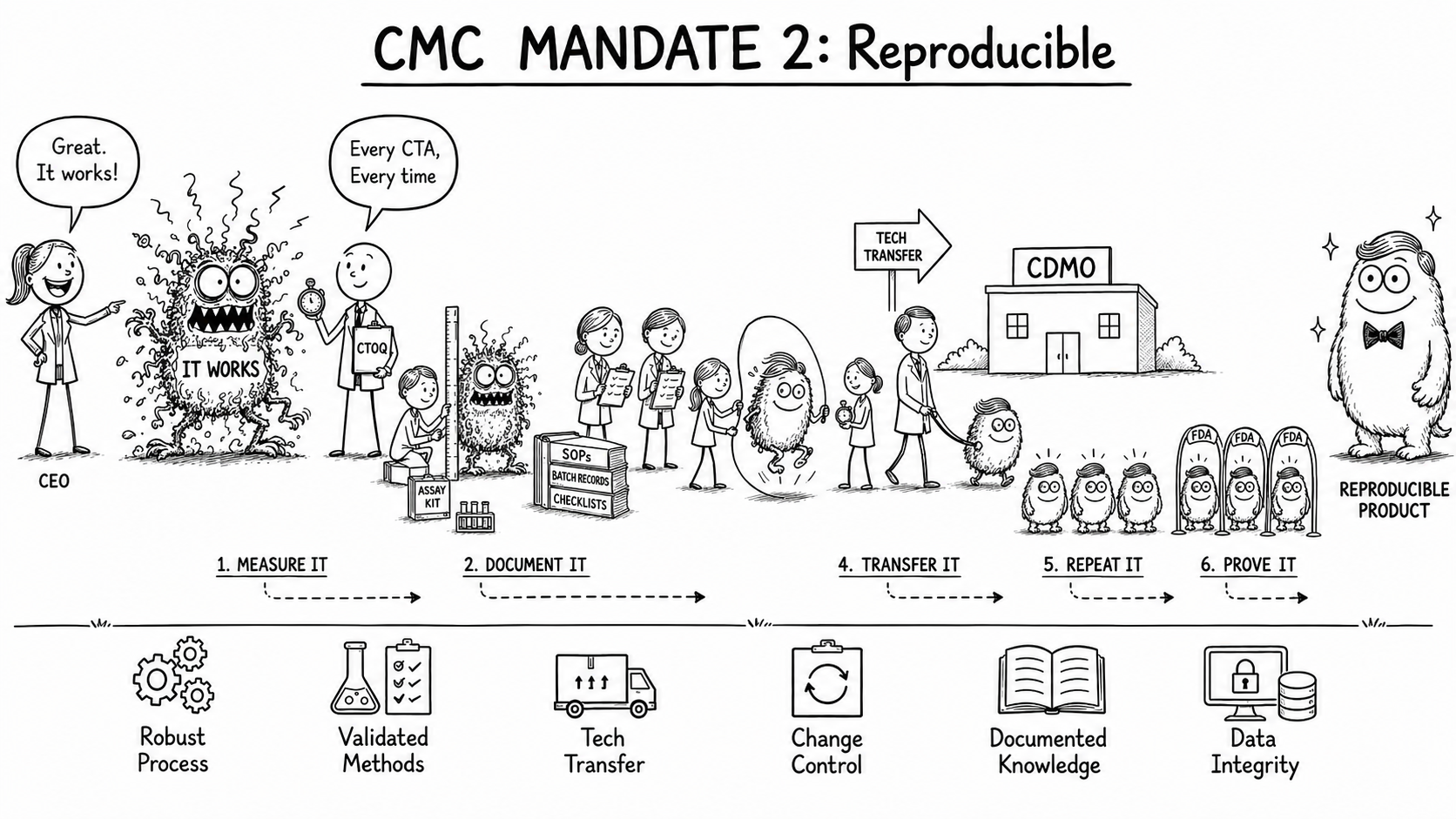
TL;DR: In the best available peer-reviewed data, 21% of advanced therapy clinical holds were attributed to CMC issues, with a mean duration of 8.4 months (Pietrusko et al., 2023), and in a peer-reviewed analysis of recent FDA Complete Response Letters, manufacturing-facility deficiencies were cited in 65% of cases and CMC in 51% (Dilek et al., 2026). The large majority of small biopharma outsource both API and finished dose, so the process almost always has to run in someone else’s building. Reproducible is the mandate that decides whether that is survivable. It is not a technical checklist. It is a question of authority, capacity, and whether the company can un-choose a decision it has already locked in.
This is Part 2 of a series on the CTO Mandate, one piece for each of the five things a technical leader is accountable for, taken one at a time. Part 1 covered Possible: whether an asset can become a product at all. This one covers Reproducible: whether you can make it the same way twice.
“It works in our hands.”
This would be the most honest sentence a process development lead could say in a tech transfer meeting that is starting to go badly. The asset does work on their bench, with their reagents, on the schedule they have run for a year. But it’s also true that just because it worked on the “home” bench does not mean that it will work on the “away” bench at scale. And this is the crux of the second CTO mandate: Reproducible, how to set up partners for success by designing a system and process that never again relies on individual brilliance.
The dominant risk has a name
The Framework calls it irreversibility masked by heroics, and that phrase does more work than it looks like it does.
Every early process decision locks in. The route, the reference standard, the acceptance criteria, the analytical method you happened to have when you needed a number. Each becomes the thing you must later prove comparability against, for the rest of the program’s life. That is the irreversibility. The masking is what makes it dangerous.
The early version of a process feels reproducible, which is exactly what makes the gap dangerous. It runs every other week. Someone always remembers what last month’s deviation was. Someone else knows the columns are near the end of their bonded life. None of that knowledge sits in the batch record. The system is working, in the sense that batches come out on spec, but it is working because of who is in the room, not because of what is on paper.
Then the change arrives. The program moves to a CDMO, doubles in scale, switches sites, or onboards a new MSAT lead. And the company discovers two things at once, in the worst possible order. That the process does not travel. And that the decisions which made it fragile were made two years ago, cheaply, by people who did not know they were making them permanent.
Why heroics happen
Nobody chooses heroics. Heroics are what is left when capacity has been cut.
The Framework is blunt about this. Capacity is the dimension most often sacrificed in a resource-constrained company, and it is the one most likely to force the heroics that substitute for systems under the Reproducible mandate. A CTO who reports a strong process development strategy but whose team is running at 130% utilization has described a plan, not demonstrated a capability. That is a board-auditable tell, and it is available to anyone willing to ask.
Underneath it sits a tension that no CMC essay ever names. Investors press to hold timelines. Technical gatekeeping is the thing that prevents the downstream failure. Those two forces point in opposite directions, and the CTO stands between them. A leader without the subject-matter depth to surface problems, or without the positional authority to act on the ones that get surfaced, will preside over decisions that optimise for speed at the expense of quality. That tradeoff compounds through every mandate that follows.
Reproducible is an authority mandate
Here is the part that separates a governance framework from a technical one. Reproducible is not a to-do list handed to a technical leader. It is a question about who holds the veto.
The Framework is specific. The authority Reproducible requires is veto over process lock, veto over validation depth, and ownership of the comparability strategy. If your CTO cannot stop a process lock that is being driven by a timeline, cannot insist on validation depth when the schedule says otherwise, cannot own the comparability strategy end to end, then the mandate is unowned no matter how good the CMC plan reads.
That is a board decision, not a technical one. It costs nothing to make and it is almost never made explicitly.
The regulatory anchors are unambiguous about what is being governed. FDA’s process validation guidance and ICH Q10 define the minimum bar: a lifecycle, not an event. Analytical methods are qualified during development and validated before filing, a progression that begins under Reproducible and completes under Scalable. Early investment in fit-for-purpose assay qualification is one of the cleanest leading indicators that a CTO is aligned to this mandate rather than describing it.
What reproducibility is worth
Now the part boards care about, and the part the technical conversation almost always leaves out.
Aligning technical leadership to reproducibility reduces the probability of rework and delay, and that tightens the discount rate an investor applies to your program. That is the mechanism. A process that can be handed to someone else and trusted to come back the same is a de-risked asset. One that only works in-house is a liability a diligence team will find, and price.
The cost of the alternative is measurable. Twenty-one percent of advanced therapy clinical holds are CMC-attributed, and they run a mean of 8.4 months against a fixed cash-out date. At approval, manufacturing and CMC deficiencies are the two most commonly cited reasons a drug is held back. And the value damage is not theoretical: multiple CMC deficiencies delayed the approval of Trodelvy, a textbook Reproducible failure that compressed seller leverage before the eventual twenty-one-billion-dollar acquisition.
That last point carries the whole argument. A manufacturing failure is addressable, and it sits inside the CTO’s mandate. A clinical failure is not, and it does not. Boards routinely fund governance against the risk they cannot control and neglect the one they can. Reproducible is the cheapest mandate to fund and the most expensive to discover.
It is also a gate. In the Framework’s own calibration, crossover and IPO investors expect Reproducible to clear a threshold before the Acquirable story can carry any weight at all. You do not get to be diligence-survivable on a process that has never left your building.
There is a leading indicator here that costs nothing to check. Ask whether your CEO can articulate the difference between process characterisation, which runs throughout development, and process validation, which is required before filing. A company where the CEO can is a company where the Reproducible mandate has been anchored at the leadership level. A company where GMP is “the manufacturing team’s problem” is one where it has not been.
The profile shifts here
Possible asked for a technical evaluator, someone whose scientific judgment set the gate on the product. Reproducible asks for a systems architect. The judgment that matters is no longer whether the science is novel. It is whether the operating model survives the next site change, the next scale change, and the next inspection without depending on the people who built it. That is a different operator, and it is rarely the same person. The founding technical leader, hired against the Possible profile, is often still in the seat when the dominant mandate has quietly shifted to Reproducible, and the board has not noticed because the science is still moving forward. Reading whether the mandate has moved is the first question we ask in CTO and technical operations searches.
The five mandates run at once. Through Phase I and II, Reproducible is the one that dominates, and whether you own it is not a matter of the stage but of the answers to these questions.
The questions Reproducible forces a CTO to answer
If reproducibility is your mandate, these are the questions you should be able to answer before the next change, and the ones you cannot yet answer that tell you where the exposure is. Run them against your lead process.
Before our next scale, site, or process change, is the comparability strategy written, signed, and specific enough that a reviewer could replicate the assessment without us in the room? If it lives in a slide, it is not yet a strategy.
Pull the last six months of deviations at the lead site. If more than a third resolve as operator error with no system cause attached, reproducibility is still a behavior, not a property of the process.
For every critical analytical method, who owns it, and what happens if that person leaves tomorrow? If the answer is that we lose six months, the method is owned by a person, not the company.
Has this process ever run to specification in a building we do not control, executed by people who were not there when it was invented? If not, we do not yet know it is reproducible; we only know it is repeatable by us.
And the question that decides sequencing: of the comparability strategy, the analytical roadmap, the tech transfer architecture, and the change control posture, which is the weakest link before our next campaign, and who is closing it? Reproducible is not a certificate you earn once; it is the answer to whichever of these is currently one change away from breaking.
Who Reproducible answers to
For the CEO, this is a capital decision wearing a technical costume. Every time capacity is cut to protect a timeline, and every time a process locks without a veto, the board has made a Reproducible decision without calling it one. The bill arrives at the pivotal campaign or the pre-approval inspection, where it resets the clock and the raise at the same time. Funding the mandate early is the cheapest way a board ever bought a tighter discount rate.
For the technical leader, this is where the job changes register. If your reproducibility lives in a few people’s heads, you do not yet have a process; you have a rehearsal that happens to keep working. Owning Reproducible means the comparability strategy, the analytical method lifecycle, the tech transfer architecture, and the change control posture are institutional, documented, and defensible before the campaign that depends on them. And it means asking for the authority to hold that line, in the room, on the record, before the timeline asks you to trade it away.
The mandate boards do not know they are voting on
Reproducible is not the mandate that fails to win board meetings. It is the mandate boards do not know they are voting on. Every capacity cut, every unvetoed process lock, every deferred validation is a Reproducible decision made without anyone naming it. Name it, fund it, and give the technical leader the authority to hold the line, and a process stops being a rehearsal and becomes an asset: one an acquirer can absorb, a regulator can audit, and a patient can depend on.
Part 3, Acquirable, looks at what a diligence team opens first. The full framework, all five mandates and where each becomes the one that decides the raise, is in the CTO Mandate Framework.
Sources
- Wills CA, Drago D, Pietrusko RG. “Clinical holds for cell and gene therapy trials: Risks, impact, and lessons learned.” Molecular Therapy Methods and Clinical Development, 2023.
- Dilek S, Woods RH, Ballreich J, Moore TJ, Alexander GC. “Deficiencies Delaying Prescription Drug Approvals by the US FDA, 2020-2024.” Therapeutic Innovation and Regulatory Science, 2026.
- U.S. Food and Drug Administration. “Process Validation: General Principles and Practices.” Guidance for Industry.
- ICH. “Q10: Pharmaceutical Quality System.” International Council for Harmonisation, adopted FDA guidance.
- Phase 3 Search. “The CTO Mandate Framework.” 2026.
If this is your discipline, let's talk.
Every engagement begins with a diagnostic — a structured read on the role and the company you are actually inheriting.
Start a diagnostic Our CTO & technical leadership practice →