
Made Under Pressure: Why a CDMO Leader Carries an Advantage
TL;DR: A stint inside a CDMO is the most compressed operator training in CMC, and the industry treats it as a detour instead of a rotation. Of the therapies the FDA approved in 2024, 74% outsourced the active ingredient and 61% finished dose, 85% and 77% for small-biopharma innovators. We have moved the operation that decides whether a molecule reaches a patient into other people’s buildings, which means the deepest hands-on manufacturing experience is now built on the contract side. This is a piece about what that experience forges in the people who do it, the one thing it does not build, and why everyone serious about technical leadership should get the chance to work in a CDMO. And with more than $480 billion of new US plants now announced under tariff pressure, the people who can actually run them are the binding constraint.
I love it when a CTO I am hiring has done a stint at a CDMO. It is one of the strongest signals on a CV I read, and the market reads it almost backwards.
For a decade I have heard the same instinct from IP-owning biotech and pharma leadership: we do not really hire from CDMOs. CDMOs cut corners. CDMO people do not understand the science. CDMO operators are commercial, not technical. The reasoning is familiar, and I think it is wrong.
Let me be plain about what this is. It is my observation across a decade of mandates, not a finding; I went looking for published evidence of a hiring penalty against contract-manufacturing backgrounds and found none. Take it as testimony from a particular seat, and as a case I want to make: that a CDMO tour forges something rare, and that far more people should get the chance to do one.
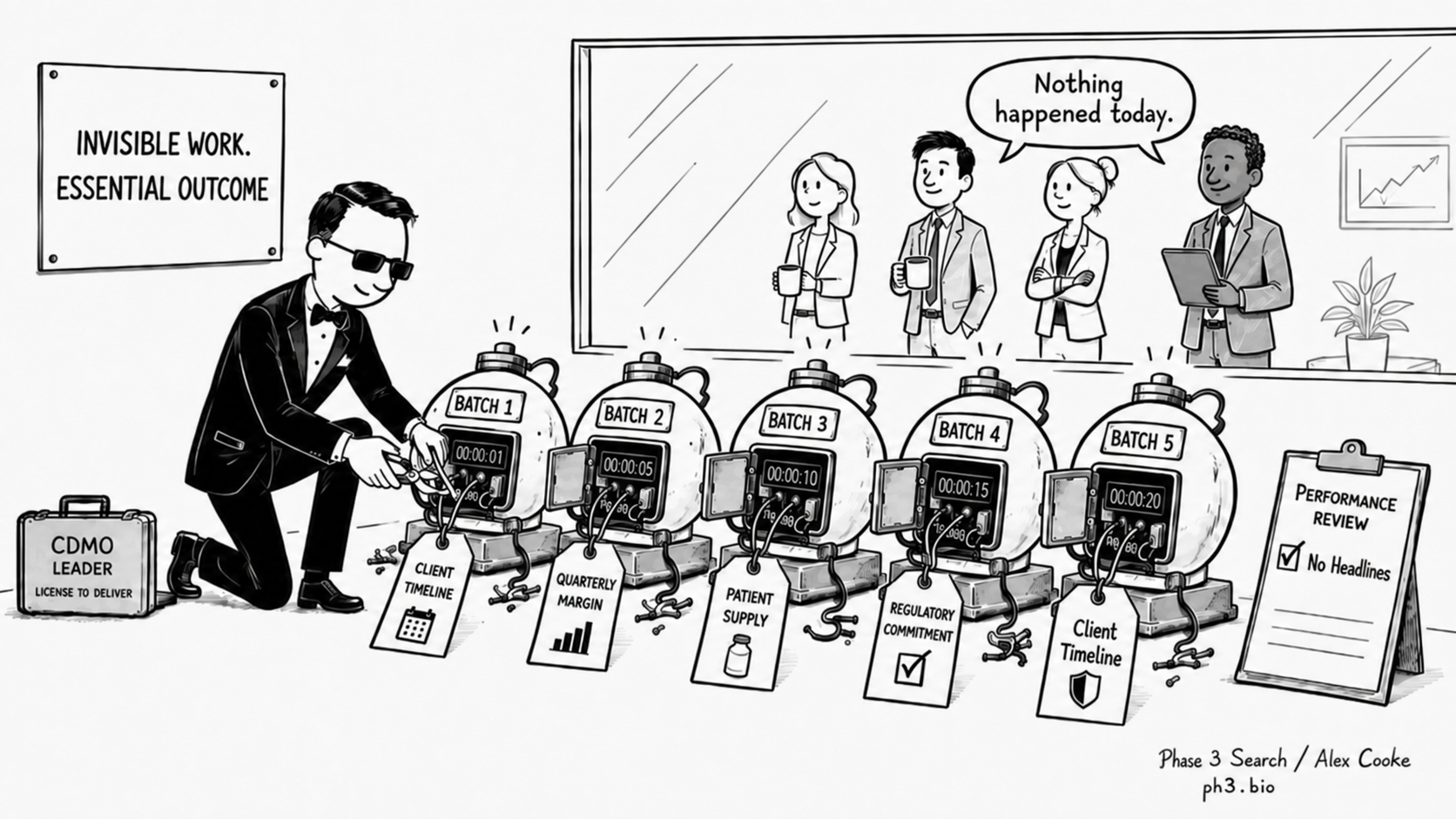
Part of why the value is missed is that it is invisible by construction. When a CDMO batch fails, it is legible: a CRL, a deviation, a headline. When it runs clean, nothing gets written down. The failures are visible and the wins are not, so a reputation built on the failures reads like judgment when it is closer to survivorship.
So the more useful question skips past trust entirely and asks what that side of the table actually forges. Look closely, and the answer becomes a case for sending far more people there.
Resilience: you’re only as good as your last batch
A CDMO is a manufacturing business. Its economics depend on platformability, minimum programme-specific change, and guaranteed revenue against committed capacity. Hold that in mind, because it is what makes the pressure on that side of the table a different animal.
Does a CDMO leader work under more pressure than their counterpart on the IP-owning side? I used to say yes. The honest answer is subtler. The magnitude is much the same. What differs is the frequency, and what sits under the trap door.
On the IP-owning side, the job is capital allocation, and the pressure comes in waves. At a venture-backed biotech it is the runway: back the right programme, hit the milestone before the cash runs out, survive to the next round. At Big Pharma it is the portfolio and the earnings calendar: capital spread across a dozen programmes, a launch to land, a patent cliff to outrun, all of it answerable when the quarter closes. Either way the pressure concentrates around the board meeting, the raise, the results day, and then it recedes.
On the CDMO side, the job is margin maximisation, and the pressure arrives a batch at a time. Suite time is booked, capacity is committed, and the margin only exists once the batch runs clean. A failed batch is a trap door: it drops the quarter’s profitability and the client’s programme through the same hole at once. For a small client with one shot at a value-inflection readout, a failed batch can be the nail in the coffin: the one chance at data, gone, in a building the client does not own. For the CDMO leader, that makes every batch a time bomb, and defusing it is the job. Miss it, and there is a crater where two reputations used to be. Defuse it, be James Bond for the day, and accept that nobody outside the building will ever know it happened.
That is the shape of the whole business. Ninety-nine batches run clean and silent, keeping the industry supplied, and you never hear about one of them. The hundredth fails and makes the trade press, and reputations are stained. Even when it never reaches the published record, it lives in the underground line between CTOs, the private coffee exchange of who is hot and who is not, who delivered and who blew a campaign.
I cannot give you a throughput number; nobody publishes that comparison, and I looked. What I can describe is the environment. A senior CDMO leader carries several client programmes at once, each a batch away from a call they do not want to make, in front of a customer who can fire them and a patient on the far end of the process.
So do not read three years on that side as three years. The volume of exposure, to processes, to personalities, to pre-approval inspections, is unrelenting and survival-critical the whole way, and it matches five years inside a large pharma. That is the compression, and it is what changes the person.
What the job builds
Two things come out of that environment. The first is resource management under customer pressure: an MSAT or QC leader running concurrent tech transfers learns to sequence work, protect throughput and triage risk in real time, and an analytical leader running methods across modalities learns which can be standardised and where the cost discipline actually lives. It is pattern recognition that lives in the substrate of the job, not in a framework anyone taught them.
The second is creativity under constraint. A CDMO leader almost never gets to run a client’s process exactly as it was handed over. They have to convert it, fit someone else’s chemistry and assumptions onto their own equipment, and still make it run clean. An internal leader that stays at one client learns a small handful of platforms deeply across a career; if they move, they learn something new. A CDMO leader learns to adapt across many from day one, and to see what breaks at the boundary where a process meets a plant it was never designed for. That adaptability and the instinct on which stones to turn over to find the killer bugs in the system is what a receiving organisation inherits.
There is a third thing, less obvious than the other two but worth naming, because it decides the payoff later. A CDMO veteran knows how a CDMO thinks, prices, and breaks, from the inside. Put them in an IP-owning seat and they manage the outsourced relationship better than anyone the captive bench produces, because they have sat in the chair on the other side of it.
The one thing it does not build
There is one real limitation, and it is worth naming precisely, because it is structural rather than personal. A CDMO is almost never the filing authority. The application, the regulatory ownership, the accountable line to the agency, sits with the client, the sponsor who owns the IP. So a CDMO leader builds and runs the operation, brilliantly, under pressure, while the strategy of taking a product through to approval belongs, by design, to someone else. They have owned how a product is made. They have rarely owned how it gets approved, because the seat that owns that has never been theirs to sit in.
That is not a reason to screen them out. It is the gap to close. And it is entirely dependent on whether the mandate is weighted toward execution of strategy. The complete technical leader fuses the two: the execution instinct the CDMO forged under cost and survival pressure, and the ownership of filing and product strategy that only the IP-owning seat can hand them.
It runs both ways
The case runs both ways. A Big Pharma leader who spends time in a CDMO learns what the captive career never forced on them: to defend a decision in front of a paying customer, to move at the relentless speed that a client and the P&L demands, to carry several programmes at once with no layers to hide behind. A CDMO leader who moves to the IP-owning side gains the filing ownership the contract seat could never give. Neither environment is the whole education. The strongest operators have worked both, and the industry would be healthier if that were the norm rather than the exception.
Where the plant actually lives
There is a structural reason this matters more every year, and you can watch it happen deal by deal. The company that owns the molecule increasingly owns none of the means to make it. In 2024 Roche sold Genentech’s Vacaville site, around 330,000 litres and one of the largest biologics plants in the world, to Lonza for $1.2 billion. Biogen sold its Danish site in Hillerød to Fujifilm, which is now replicating it at more than $3.2 billion in North Carolina. In 2026 GSK handed its Rockville site to Samsung, the Korean group’s first plant on US soil. Bayer, Pfizer, Bristol Myers Squibb and Sanofi have all run versions of the same play. Big pharma has stopped treating manufacturing ownership as strategic, and the plants are moving to the CDMOs one billion-dollar transaction at a time.
And the people go with the buildings. Roughly 750 Genentech staff moved to Lonza with Vacaville; about 800 Biogen staff moved to Fujifilm with Hillerød; another 500 or so moved with GSK’s Rockville site to Samsung. The operating expertise is not just concentrating in the CDMOs, it is being transferred into them, name badge by name badge, with the sites themselves.
Which is the strongest reason of all to treat a CDMO tour as a rotation, not a detour. The plant, the capacity, and the people who ran it are moving to the contract side, and the operating knowledge is moving with them. If that is where the machine now lives, that is increasingly where you go to learn it. The circuit should run both ways: into a CDMO to learn the machine at the scale it now operates, and back out to run it for the companies that depend on it.
There is a catch in all this that the sellers understand better every year. Handing a plant to a CDMO sheds the overhead and the headcount, but it buys dependence. When you no longer own the building, a bad batch is still your problem, and you can no longer walk onto the floor to fix it. A blown campaign at a contract site can slip a launch or move a public company's share price on a morning nobody saw coming, and the client, holding none of the controls, comes down on the CDMO with everything it has. Shoring up supply and buying back that exposure is a large part of what is driving the wave that comes next.
And now the plants are coming home
There is a second force arriving at the same time, and it turns the talent question from academic to urgent. Under the current administration, manufacturing is being pulled back onto US soil, and pharmaceuticals sit near the front of the queue. A Section 232 national-security investigation into pharmaceutical imports opened in April 2025. A year later the tariffs followed: a default rate of 100% on patented drugs and their active ingredients, phased in through 2026, and structured to reward the companies that commit to build here.
And the tax code turned to match. The 2025 reconciliation law let companies write off the entire cost of a new US factory in the year it opens, the building and fit-out included, rather than depreciating it over decades. It made the same immediate write-off permanent for equipment, and let domestic research be expensed in full while foreign research kept the slower treatment. Put the tariff and the tax break side by side and the signal is single: build it here, and build it now.
The companies read the signal and moved. Eli Lilly opened the wave in February 2025 with $27 billion for four new US sites, three for active ingredients and one for injectables, lifting its domestic commitment past $50 billion. Johnson & Johnson followed with more than $55 billion over four years. Novartis committed $23 billion, Roche $50 billion, and AstraZeneca $50 billion, the last anchored by a single $4.5 billion drug-substance plant in Virginia that it calls its largest manufacturing investment anywhere in the world. Amgen put roughly $900 million into Ohio and about a billion more into North Carolina. Novo Nordisk added a $4.1 billion fill-finish plant in Clayton, the largest life-science investment in North Carolina's history. Gilead, Merck, Sanofi and Pfizer have each pledged their own. Add it up and it is more than $480 billion across the sector, around 22 new manufacturing sites, and roughly 44,000 new jobs.
Which raises the one question none of the announcements answers. Who runs them?
You can build a plant with capital and twenty-four months, if a cascade of miracles holds. You cannot conjure the people who run it on the same schedule. A biologics suite needs process leaders, MSAT, QC, QA and validation staff who have done it before, under GMP, with a regulator watching, and the pipeline for those exact people was thin before a single new site was announced. Deloitte puts the US manufacturing shortfall at roughly 3.8 million workers by 2033, with up to 1.9 million roles unfilled on current trends. In pharma specifically, industry surveys have around four in five manufacturers reporting a gap between the skills their people have and the ones the work now demands. Forty-four thousand new pharma-manufacturing jobs land straight into that shortfall.
So where does the talent come from? Some will be trained from scratch, and should be. But the people who can walk into a new plant and run it from day one are the ones who have already run plants under pressure, and a growing share of them sit on the CDMO side, in the buildings that never stopped making product for other people. The reshoring wave changes the stakes. A bias against CDMO operators was always a mistake. Now it is one the country cannot afford. If we are going to pour half a trillion dollars into capacity, we need the people who know how capacity behaves when a batch fails at two in the morning. That is the CDMO operator's first language. It is why, in our CDMO executive search work, the shortlist leans harder on contract-manufacturing operators than most sponsors expect.
The rotation everyone should get
So here is the argument, put plainly. The CDMO leaders I have placed into IP-owning biotechs arrive having run more comparability studies and managed more concurrent tech transfers than most internal leaders ever will, and they are fluent in the one conversation that matters: saying what you do not know, early, to someone whose money is on the table. That fluency is earned, batch by batch, on the side of the table where you are only as good as your last one.
So I would go further than “stop screening these people out.” The experience is valuable enough that far more people should seek it. A tour in a CDMO, early or mid-career, builds an operator the captive bench cannot: pressure-tested, cost-fluent, creative under constraint, and able to read a manufacturing partner from the inside. If you run technical operations and have never worked on the contract side, that is not a disqualification, but it is a gap worth closing on purpose.
The industry that treats a CDMO stint as a development rotation rather than a detour will build better technical leaders and a healthier talent market, and it will get more medicines made well, on time, in buildings it does not own. That is the whole case, and it is a hopeful one. It is how you forge the people the outsourced era actually needs.
Next, and last in the CDMO series: why the large brand-name CDMOs face a different version of the problems that small CDMOs do and why scale solves less of it than their clients assume.
Sources and notes
Outsourcing penetration: Max Smock CFA, Matt Larew, Christine Rains CFA, “Updating FDA Approval Analysis for 2024 Data,” William Blair Equity Research, 26 February 2025. Both cuts are per approval, not per company, and cover drugs whose outsourcing status was determinable. 2024 was a record year: the 2015-2024 averages are 59% API and 49% finished dose across all approvals, and 78% and 69% for small-biopharma innovators. Sell-side research; the analyst covers the CDMO subsector.
Dependence: BIO member survey, May 2024, n=124 companies (68% under 250 employees): 79% had at least one contract or product supported by a China-based or China-owned CDMO. BioPlan Associates 22nd Annual Report (April 2025): 82.6% of cell and gene therapy companies outsource at least some manufacturing; only 17.4% keep all of it in-house, down from 30.4% a year earlier. GAO-24-107359 (February 2024): 58% of the more than 4,800 establishments making drugs for the US market were located overseas as of October 2022.
Capacity migration: Roche sold Genentech’s Vacaville, California biologics site (about 330,000 litres, among the largest in the world) to Lonza for $1.2 billion, announced and completed in 2024 (Lonza; BioPharm International). Biogen sold its Hillerød, Denmark site (six 15,000-litre bioreactors) to Fujifilm Diosynth for approximately $890 million in 2019 (Fujifilm; Biogen). Fujifilm’s Holly Springs, North Carolina campus is a build of more than $3.2 billion, opened 2025 (NC Commerce; Fierce Pharma). Bayer sold biologics sites to WuXi Biologics in Leverkusen and Wuppertal, Germany (2019-2020), and Pfizer sold one in Hangzhou, China (2021). In 2026, GSK sold its Rockville, Maryland site (formerly Human Genome Sciences, 60,000 litres, about 500 staff) to Samsung Biologics for $280 million; Bristol Myers Squibb sold a Phoenix, Arizona sterile site to Rovi’s Rois; and Sanofi sold a Maisons-Alfort, France fill-finish site to Adragos (Samsung; Fierce Pharma; Pharma Manufacturing, 2026). Staff-transfer figures, roughly 750 Genentech employees to Lonza and about 800 Biogen employees to Fujifilm, are from the deal announcements. This is a direction-of-travel argument. On a static basis, captive manufacturers still held the larger share of installed mammalian-cell capacity as of BioPlan Associates’ 2023 survey (CDMOs about 25%); the point in the text is the flow, which runs from IP-owner to contractor.
Hiring bias against contract-manufacturing backgrounds: no published evidence exists, in any tier. The claim in this piece is my observation from a decade of mandates and is offered as testimony, not as a finding. The adjacent literature cited is: Bidwell M, Won S, Barbulescu R, Mollick E, Strategic Management Journal 2015 (prior-employer status as a labour-market signal); Bidwell M, Administrative Science Quarterly 2011 (external hires paid ~18% more, perform worse for ~2 years); Paolini S, et al., Psychological Bulletin 2024;150(8):921-964 (negative information outweighs positive). None of these studies concern pharmaceutical hiring; the mapping onto CDMO careers is mine.
US reshoring wave (company commitments from company announcements and 2025 trade-press coverage): Eli Lilly, $27 billion for four new US sites, 26 February 2025, lifting its post-2020 US total above $50 billion (Lilly; CNBC; BioPharma Dive). Johnson & Johnson, more than $55 billion over four years, March 2025 (J&J). Novartis, $23 billion over five years, 10 April 2025 (Novartis; BioPharma Dive). Roche, $50 billion over five years, 22 April 2025 (Roche; CNBC). AstraZeneca, $50 billion by 2030 including a $4.5 billion Virginia drug-substance plant, 21 July 2025 (AstraZeneca; Fierce Pharma). Amgen, about $900 million in Ohio and roughly $1 billion in North Carolina, 2025 (Amgen). Novo Nordisk, $4.1 billion for a second fill-finish plant in Clayton, North Carolina (Novo Nordisk; Fierce Pharma). Gilead (to about $32 billion total), Merck (a $3 billion Virginia site), Sanofi (at least $20 billion through 2030) and Pfizer (a $70 billion R&D-and-manufacturing agreement) have made their own commitments. Sector aggregate, more than $480 billion, about 22 new manufacturing sites and roughly 44,000 jobs: Think Global Health and DCAT Value Chain Insights onshoring trackers, and Pharmaceutical Commerce (2025-2026). These are announced intentions over four-to-ten-year horizons, not completed spend.
Policy driver: the US Commerce Department opened a Section 232 national-security investigation into pharmaceutical imports on 1 April 2025. A proclamation of 2 April 2026 imposed Section 232 tariffs on patented pharmaceuticals and their active ingredients at a default rate of 100% ad valorem, phased in during 2026 (from 31 July 2026 for 17 named companies and 29 September 2026 for other importers), with lower rates for certain allied trading partners and preferential treatment for companies holding US onshoring agreements. These Section 232 duties were unaffected by the Supreme Court's 20 February 2026 decision striking down the separate IEEPA tariffs, which rest on different legal authority (Foley Hoag; Thompson Hine; Perkins Coie; BioPharma Dive).
Tax incentives: the One Big Beautiful Bill Act, enacted 4 July 2025, restored permanent 100% bonus depreciation for qualifying equipment (placed in service after 19 January 2025) and, under new Section 168(n), allowed 100% first-year expensing of qualified production property, meaning domestic non-residential buildings used in manufacturing or refining where construction begins after 31 December 2024 and the property is placed in service before 1 January 2031. New Section 174A made immediate expensing of domestic research permanent, while foreign research stays on 15-year amortisation (BDO; Cohen & Co; Grant Thornton; RSM).
Workforce gap: Deloitte and the Manufacturing Institute estimate US manufacturing will need about 3.8 million workers by 2033, with up to 1.9 million roles unfilled on current trends; that figure is for all US manufacturing, not pharma alone. The pharma-specific skills-mismatch figure (around four in five manufacturers reporting a gap) is from 2025-2026 industry surveys reported by ISPE Pharmaceutical Engineering and BioPharm International. Treat both as directional.
Not claimed here, because no source supports it: any count of tech transfers or analytical methods managed by a typical CDMO leader versus an internal one; any tech transfer success or failure rate; any comparability-failure rate on transfer between sites.
If this is your discipline, let's talk.
Every engagement begins with a diagnostic — a structured read on the role and the company you are actually inheriting.
Start a diagnostic Our CDMO search practice →