
Big CDMO, Different Risk: What Scale Buys You, and What It Bills You
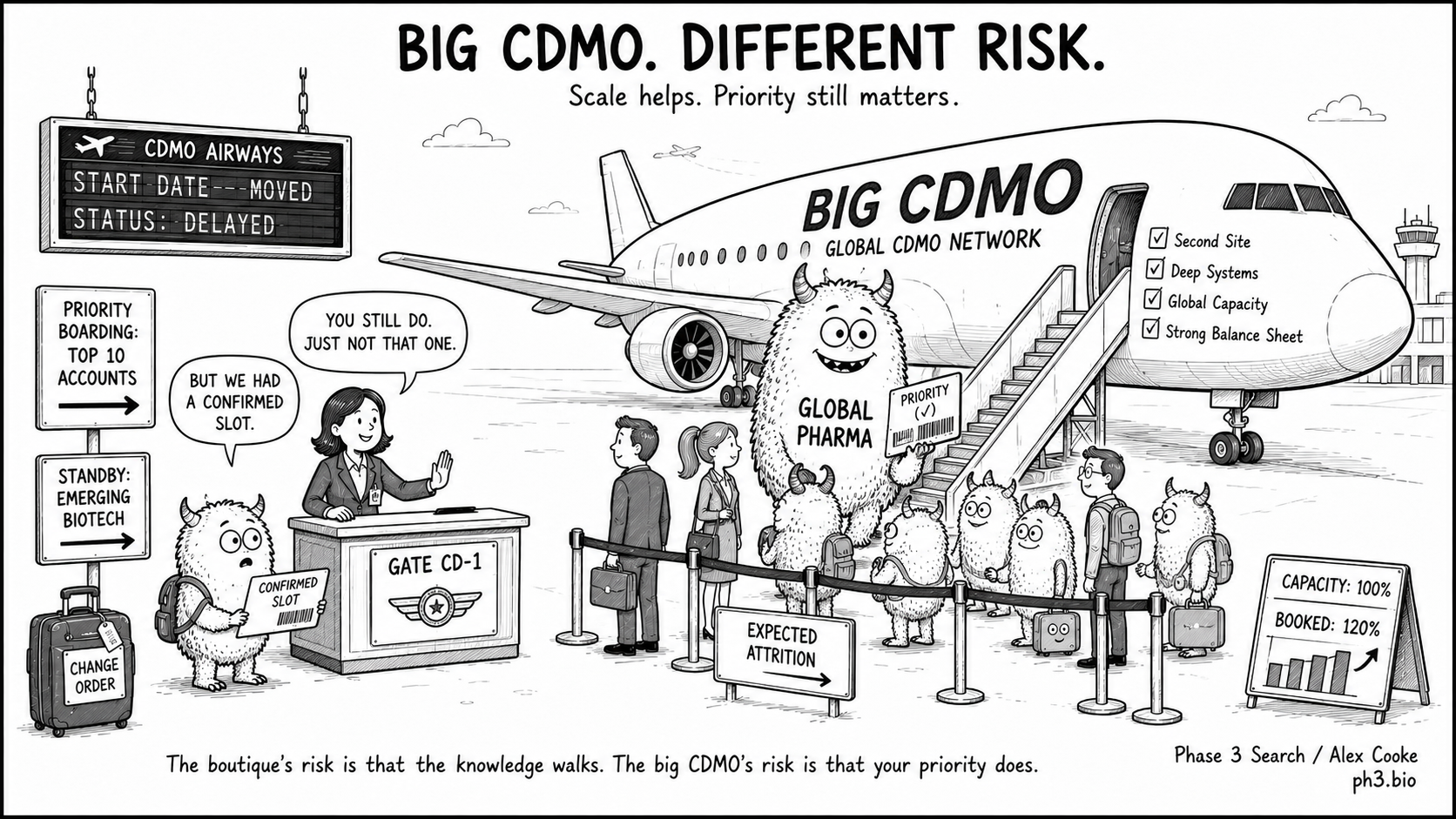
TL;DR: The instinct that a bigger CDMO is a safer CDMO is half right, and the missing half is where the money is lost. Scale buys things a boutique cannot offer: a real second qualified site, the depth of systems that survives a key departure, and a balance sheet strong enough to vet early programmes like a venture investor and carry the ones that fail. What scale does not buy is safety. It converts your risk. You stop being a client and become a position in a portfolio that is managed for the portfolio's return, not for yours. You can be oversubscribed against a drop rate that never arrives, bumped when a larger client signs, repriced when new leadership resets the margin, and metered like a consulting engagement where every change of scope is a fresh invoice. Choosing scale is not choosing safety over risk. It is choosing a different risk. This is how to tell which one you have bought.
For a decade the reflex on the sponsor side has run one way. When a programme matters, you take it to a big name. The logic is sound as far as it goes, and I want to give it its full weight before I complicate it, because the complication is where sponsors lose money and time they cannot get back.
First, size the field honestly, because the picture of a few giants swallowing the market is wrong. The CDMO market is worth somewhere north of two hundred billion dollars, and the five largest firms together hold roughly a quarter to a third of it, with even the leader sitting only in the low-to-mid teens. This is scale without dominance. When you choose a big CDMO you are not buying market power. You are buying operational depth, and operational depth is a real thing worth paying for.
What scale actually buys
Start with what a large CDMO can do that a boutique cannot, because it is real and it is the reason the reflex exists. It can build you a second site. Not a slide that says business continuity, an actual second plant that can make your product. When Biogen sold its Hillerød campus in Denmark to Fujifilm, Fujifilm did not just run it. It built a clone of that site, more than three billion dollars of it, in Holly Springs, North Carolina, the same design and quality systems on another continent, so a programme can move between the two. That is redundancy a single-site operator cannot offer at any price, and if your fear is a plant going down, scale is the only credible answer on the market.
It can also afford to be a venture investor. A large CDMO sees hundreds of early programmes a year and can run them as a portfolio, taking a spread of bets in the knowledge that a good number will die in the clinic and never reach commercial supply. It can carry that failure because the winners pay for it. A boutique cannot. A boutique that takes three programmes and watches two die is not running a portfolio, it is fighting for its life. So the big CDMO can say yes to the interesting, unproven, pre-data company the small shop cannot afford to touch. For an early sponsor, that willingness to bet on you is a genuine gift.
The overbooking you are not shown
Here is where the same strength turns. To make a portfolio of bets pay, a large CDMO does what an airline does with seats. It oversubscribes. It books capacity beyond what it physically has, perhaps a fifth again, on the sound assumption that a predictable share of programmes will drop out before they ever run. Attrition is not a risk to that model, it is the input the model depends on. Most years the maths is quiet and everyone gets their slot.
The trouble is the year the maths misfires. When the expected drop-off does not come, when more of the book survives than the model assumed, the plant is genuinely oversubscribed, and physical capacity does not stretch to meet a spreadsheet. Now the CDMO has more committed demand than it has suites, and it has to choose. It will not tell you it is choosing. You will simply find your start date has moved.
Who gets bumped, and it is not the whale
The choice is not random. When a larger customer walks in, or an existing one expands, the small programmes are the ones that slide. Your slot was never really yours. It was leased to you against your continued relative importance to the book, and the day a more important client signs, the lease is quietly rewritten. The boutique's failure mode is that it cannot absorb your problem. The large CDMO's failure mode is that it can absorb you, into a queue you do not control, behind clients you cannot see.
The relationship you signed is not the one you keep
There is a slower version of the same risk, and it arrives with a change at the top. A large CDMO is a business with owners and quarterly targets, and a new leadership team, or a new owner, often arrives with a mandate to lift margin. Margin at a contract manufacturer is lifted by pruning, shedding the low-priced, low-volume, high-attention accounts that a founder-era commercial team took on to fill the plant. Those accounts are frequently the smaller sponsors. A relationship that was warm and workable under one regime can, within a quarter of a leadership change, become an account flagged for repricing or exit, and the sponsor is left doing an unplanned supply rethink at exactly the moment they have least slack. Nothing was breached. The strategy simply changed above your head.
Metered like a consulting engagement
The last cost is the one sponsors notice only in the invoice. A large CDMO runs a commercial machine a boutique does not, and it behaves the way a big professional-services firm behaves. The scope is defined tightly, and everything outside it is a change order. Move the process, add an analytical method, change a specification, ask for an extra person on a call at short notice, and the bill grows a line at a time. Change the mandate and you are quoted a new fee. None of this is improper, and a well-run sponsor budgets for it. But the sticker price on the master agreement is the floor, not the number you will pay, and the gap between the two is widest precisely for the inexperienced sponsor who does not yet know which questions move a price.
Relationships are the other currency
Which is why, at a large CDMO, relationships are a currency in their own right. When every change of scope is a fresh invoice, a long-standing relationship with the team on the floor is what gets a change waved through, a slot held, an awkward call taken on a Friday night. A small-cap CTO who has known the people at a major CDMO for years is worth her weight in gold to a board, because she does not pay the inexperience premium and she does not lose her place in the queue as easily as a stranger does. That goodwill sits on no balance sheet, and it is one of the most valuable things a technical leader can carry into a small company.
Scale pointed the right way
None of this is an argument against scale. It is an argument for reading it correctly, because scale aimed at delivery rather than extraction is the best partner in the industry. The clearest case is WuXi Biologics, a firm many Western sponsors would not have touched a decade ago. When I first placed into that market, WuXi sat somewhere between an unknown and a liability in the minds of the sponsors I worked with, and I heard it said in the room. That is my recollection, not a dataset.
The dataset is the inspection record, and it is a strong one. No FDA warning letter or import alert for WuXi Biologics has been located across the 2021 to 2026 window, and its record ran notably clean until a Form 483, a set of investigator observations, at its Irish site in December 2025. It rebuilt its reputation the only way that lasts, by being consistent to work with, batch after batch, until consistency became the brand, and it has deliberately cut its reliance on its single largest customer even as it grew. Its live exposure is now legislative rather than operational, and even there the detail rewards attention: WuXi AppTec was added to the US Section 1260H list of Chinese military companies in June 2026, and WuXi Biologics was not. Pointed at delivery, scale compounds trust. The question is only ever where it is pointed.
So which risk did you buy?
Put the two ends of the market side by side and the choice is not safety against danger. The boutique keeps its answer in a person, and the person can leave, burn out, or simply be somewhere else the week you need them. The large CDMO keeps its answer in a system, and the system is optimised for the portfolio's return, which is not the same as yours. One risk is that the knowledge walks. The other is that the priority does. Neither is wrong to choose. It is wrong to choose either without knowing which one you are holding.
What to actually ask a large CDMO
So the diligence is not about the brochure. Four questions tell you more than a site tour.
- How oversubscribed is this line, and what is your assumed drop rate on the book it sits in? You are really asking whether your slot depends on other people's programmes failing on schedule.
- When a larger client signs after me, what protects my start date, and is that protection in the contract or in a handshake?
- If your ownership or leadership changes, what happens to an account my size? Ask for the last time it happened, and what became of the accounts that looked like mine.
- Show me your change-order history on an account like mine. What did the master price become over eighteen months, and what moved it?
The answers you want are specific, with a number and a name in them. The answer that should worry you is a smooth reassurance with neither.
Where we come in
At Phase 3 Search we sit on both sides of this. We place the leaders who run these networks and set their margin mandates, and we advise the sponsors and biotech CMC teams choosing which door to walk through. The value is rarely in the capacity number. It is in knowing, before you sign, whether the firm across the table built its scale to deliver or to extract, and whether the person who will actually carry your programme has the standing to defend your slot when a bigger client calls.
The kings of execution
One last thing, and it is the thing I most wanted to say. If you have spent your career on the CDMO side, know that the work is seen, and that it matters. The skills a CDMO builds, running someone else's process under cost and survival pressure, defusing the failed batch nobody will ever hear about, converting chemistry onto equipment it was never designed for, are built there and almost nowhere else. That is not a lesser craft. It is the craft of execution, and the people who carry it are the kings of it.
The IP-holding companies own the strategy. The CDMOs own the execution. Neither makes a medicine alone. The beauty of this industry is the moment the two come together, strategy and execution, molecule and plant, and something leaves a building that keeps a patient alive and changes a life. That is what all of it is for, and it is worth remembering that the people who run the plants are as much a part of it as the people who own the science.
Sources and notes
Redundancy example: Fujifilm acquired Biogen's Hillerød, Denmark biologics site in 2019 and has built a large-scale cell-culture site at Holly Springs, North Carolina to a common design (Fujifilm's harmonised KojoX model), described in trade coverage as a clone of the Danish facility, with first-phase operations from 2025 and further expansion of roughly $1.2 billion on top of the original build, taking the North Carolina site above $3 billion (Fujifilm; Pharma Manufacturing; GEN; Fierce Pharma).
Market structure: estimates of the CDMO market's size for 2025 cluster between roughly $170 billion and $260 billion depending on scope and definition, commonly cited at or above $200 billion (GlobalMarketInsights; Precedence Research; Mordor Intelligence). Market-share estimates put the five largest players (Lonza, Thermo Fisher, Catalent, Samsung Biologics, WuXi Biologics) together at roughly 30%, with Lonza the leader above 12%. The precise figures move with the denominator used (CDMO versus the broader CRDMO market, biologics-only versus all modalities), so read them as orders of magnitude; the text relies only on the uncontested part, that the industry is large and fragmented and no single firm dominates it.
WuXi Biologics: no FDA warning letter or import alert for WuXi Biologics was located across the 2021 to 2026 window; the firm's Irish site received a Form 483 dated 16 December 2025 (Redica Systems; PharmaCompass). A Form 483 records an FDA investigator's observations and is not a finding of violation. WuXi Biologics discloses declining customer concentration in its 2025 annual report; the direction, not any single percentage, is what the text relies on. Section 1260H: the US Department of Defense added 65 entities to the Section 1260H list of Chinese military companies on 8 June 2026, including WuXi AppTec; WuXi Biologics and WuXi XDC were not listed (DoD; Ropes & Gray; WilmerHale; Fierce Pharma). The characterisation of how WuXi's reputation changed over a decade is my own recollection of the market, not a measured finding.
Change-order economics: scope creep and change orders against a fixed master price are a widely documented feature of CDMO contracting, especially in fee-for-service process development, where excluded scope re-enters as billable change orders and can add materially to a multi-year programme's cost (Outsourced Pharma; DrugPatentWatch). Framing the effect as consulting-style metering is mine.
Practitioner observations: the other commercial dynamics described here, vetting early programmes like a venture portfolio, oversubscribing capacity against an expected attrition rate, and re-ranking or pruning smaller accounts when a larger client signs or when a leadership or ownership change resets the margin mandate, are my observations from a decade of search mandates and sponsor conversations, offered as pattern rather than as sourced statistics. No CDMO publishes its oversubscription ratio, so the "about a fifth again" figure is illustrative of the practice, not a measured rate.
If this is your discipline, let's talk.
Every engagement begins with a diagnostic — a structured read on the role and the company you are actually inheriting.
Start a diagnostic Our CDMO search practice →