
CMC — The Clark Kent / Diana Prince of the Boardroom
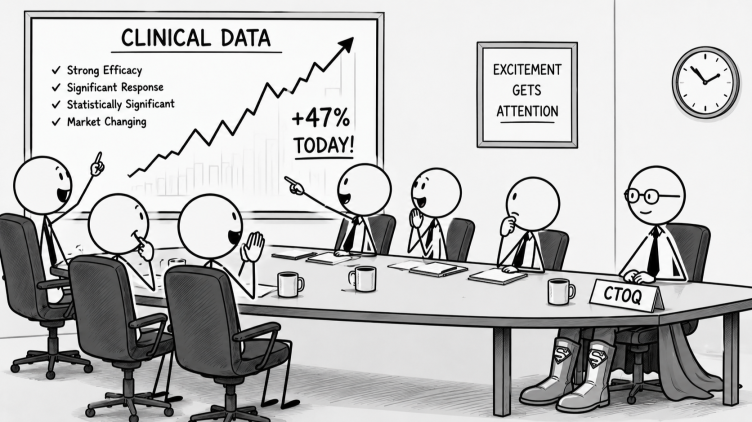
TL;DR: There is a point in every program where the work changes from inventing a process to supplying it at scale for the next decade. That is the CMC inflection, and it gets governed badly more often than well. Part of the reason is human. People pay attention to excitement, and a board is a room of people with scarce time and a long agenda. The gold standard of CMC is the opposite of exciting: totally managed, predictable supply. No dramas. No deviations. No exceptions. A function whose excellence looks like nothing happening is hard to govern in a room wired to follow drama. CMC is the boardroom’s Clark Kent and Diana Prince: unremarkable in the meeting, and the Superman or Wonder Woman the company needs when a crisis hits.
“Let’s keep the CMC update short so we have more time for the clinical data.”
Some version of that sentence gets said in biotech board meetings constantly, and it almost never comes from a careless board. It comes from a reasonable instinct about where the value and the risk in a program sit. The clinical readout is the moment the company is built around. It is binary, it is dramatic, and it can move the valuation in a single afternoon. Manufacturing, next to that, feels like operational housekeeping. The instinct is measuring the wrong thing, and it is most expensive at one specific moment: the inflection point where a company stops inventing a process and starts having to supply it, reliably, for years.
Why the boardroom rewards excitement
We pay attention to excitement. That is how human attention works, and a board meeting is an attention market, where focus flows to whatever is most uncertain and consequential. For most of a company’s life that is the science: will the molecule work, will the readout clear the bar, will the partner sign. Those questions are exciting because their outcome is unknown and enormous.
CMC does not present that way. Done well, it presents as unremarkable. A clean batch. A tech transfer that closed on schedule. The work shows up as the absence of a problem, and a board cannot get excited about an absence. So the function that carries an outsized share of late-stage risk gets the least attention, precisely because it is working.
Excitement is a poor proxy for risk. By late stage the manufacturing and quality exposure is often the larger uncontrolled variable, and no one in the room found it interesting enough to govern.
Mild-mannered until the crisis hits
This inflection calls for a specific kind of leader, and it is not the one an early company is built to celebrate. Think Clark Kent and Diana Prince. On an ordinary day they are unremarkable by design: steady, quiet, under the radar. Then on the day the company is in real trouble, the disguise drops: Clark Kent becomes Superman, Diana Prince becomes Wonder Woman, and they are the one who saves it. That is the CTOQ at the commercial inflection, fusing the technical and quality remit. They are paid for two things: to build a system that makes supply so predictable it is invisible, and to carry the company through the crisis no one saw coming. Every batch in specification, every release uneventful. And on the day a deviation could turn into a recall, one steady operator who already knows what to do. The leader who proved the science is rarely the one built for this.
The fastest precursor to board support is trust. A board backs the leader it trusts more than the function it finds interesting. So the task is to build that trust before you need it, and it is almost certainly not achieved by walking board members through something they find dull over lunch. Trust in this seat is built the way it is built anywhere: by naming a risk before it hits, by being right about a timeline that was doubted, by handling the one exciting day so well that the next twenty boring quarters speak for themselves.
Who drives the transition, and when
A transition like this gets driven one of two ways. The board can drive it, which usually means late: when something is on fire, or in the cleanup after one. Or the CTOQ can drive it, early and on purpose, before there is a fire to point at. The first mode costs far more than the second.
Boards run late for understandable reasons. The early team is still performing, nothing looks broken, and the inflection does not announce itself. The signal to begin is not a failure. It is a stage.
The window opens when the process you are running becomes the process you will sell. In a traditional small-molecule or antibody program that often falls near the end of Phase 2, as the work turns from finding the process to fixing it. The markers cluster there: the process about to be locked for registrational material, a tech transfer to commercial scale being scoped, the CMC sections of a BLA or NDA taking shape, methods that were fit for an early study now needing validation. Each is a sign the job has changed from invention to reliable reproduction.
But the phase number is the wrong thing to anchor to. Breakthrough and RMAT designations, accelerated approval, and seamless Phase 1/2 designs all pull that window forward. In cell and gene therapy it can open at first-in-human, because the process is the product, comparability is unforgiving, and the material that treats your first patients may be the material you file on. The faster the clinical path, the earlier reliable reproduction has to be solved, and the more it costs to learn that late.
The board’s question is rarely whether the team is good. It almost always is. The real question is does the company have the leadership for the phase it is entering, in the seat, before that phase forces the issue? By the time a deviation trend or a failed inspection makes the gap visible, the cheapest moment to act has already gone. Done early, the transition is a planned move. Done late, it is damage control.
Board: how to make the transition
The mistake is to treat this as a swap, the inventors out and the operators in. It is expensive both ways: it discards the company’s most valuable asset, the knowledge of why the process is built as it is, and hands new leaders a system whose rationale they do not carry. The cleaner path runs in three phases.
Pre-transition
Bring the systems builder, your Clark Kent or Diana Prince, in before the inflection forces it — early enough to design the handoff rather than inherit a crisis. Map where decision authority will sit once the process locks, and name the knowledge that has to be written down before anyone moves.
Transition
This is not two heads of CMC running side by side; there can only be one. It is a deliberate transfer of knowledge, even as accountability sits with a single leader. In development that knowledge generated options. Now it moves from tribal to structural — out of people’s heads and into the process description, control strategy, comparability protocols, validated methods, and training. You cannot teach talent. You can only teach a system. And you can only teach a system to those willing to learn. So you use the talent you already have to design the system while it is still theirs to give, and you are left with something that scales.
Post-transition
Your new Clark Kent or Diana Prince owns supply, and the founding team moves to where it is most valuable. Some stay. Not everyone does, and not everyone is meant to. They ran their leg of the relay, and they ran it brilliantly. The person who is wrong for this phase is often exactly right for another company’s early stage, and runs that leg just as well there. The test of a finished transition is simple: the system holds when the people who invented it are no longer in the room. Naming who goes where is a question of phase and fit, not of worth, and it belongs on the board’s agenda because it touches succession, capital allocation, and the risk the board is accountable for.
CMC: how the leader drives the transition
The CMC leader living the inflection usually sees it first, but raising it risks putting their own competence on trial. Ask the wrong way and the board’s honest reply is “that’s why we have you,” or worse, “that’s why I thought we had you.” That second version is past tense and is the sound of trust leaving the room.
The test for every question is whether it asks the board to do your job or hands them a decision only they can make. Whether a method will validate, or who owns comparability, is execution, and raising it open-handed signals you have not gripped it. Capital, headcount, timing, and risk appetite are the board’s, and naming those is leadership.
So ask from a position of command. Own the work, put the risk in dollars and time, and hand the board the one call that is theirs. “I have found a method that will not validate as written. I am fixing it. Done properly it costs a quarter, rushed it carries risk into our filing, and I want us aligned on which trade we make.”
The strongest version puts your own seat in play, on your own terms. “Too much of our supply depends on a few people, me included. That is a risk to the company, not a credit to me, and here is how I am building the team that removes it.” That turns “that’s why we have you” into “you should not only have me.” The leader who waits for the board to notice the gap has already lost the room.
What the board needs to ask
You do not need a new committee. You need a few questions on the agenda before the inflection, not after.
Ask when the process locks, and who owns supply the moment it does. Ask the key-person question without softening it: if we lost our CTOQ tomorrow, would supply hold? And does the person in that seat know how to build the team that delivers predictability, or only how to deliver it personally? Ask what happens to the timeline if your primary CDMO relationship changes. Ask whether your most important CMC decisions could be reconstructed from the documentation alone, without the people who made them on hand to explain. None of those questions are exciting. Every one of them decides whether supply holds.
To close
The boards that handle this well stop letting excitement decide where they look. They learn to read a quiet function as a well-run one, and to treat the handover between teams as a planned move rather than a rescue. They keep the knowledge, redeploy the people, and give the leader whose job is predictability a seat the board can see.
A late-stage biotech rarely loses on the science it spent a decade proving. It loses on the supply of that science: the batch that failed, the method that would not validate, the inspection that found a system held together by memory. Those are the quietest ways to lose a company, and the easiest to miss until it is too late.
Which brings us back to an undeniable fundamental: there is a patient waiting at the end of every batch, and the most important outcome is the least exciting outcome — product that reaches the patient on time, on spec, and in the right place to make a difference.
If this is your discipline, let's talk.
Every engagement begins with a diagnostic — a structured read on the role and the company you are actually inheriting.
Start a diagnostic Our CTO & technical leadership practice →