
What a Diligence Team Opens First (Mandate 3: Acquirable)
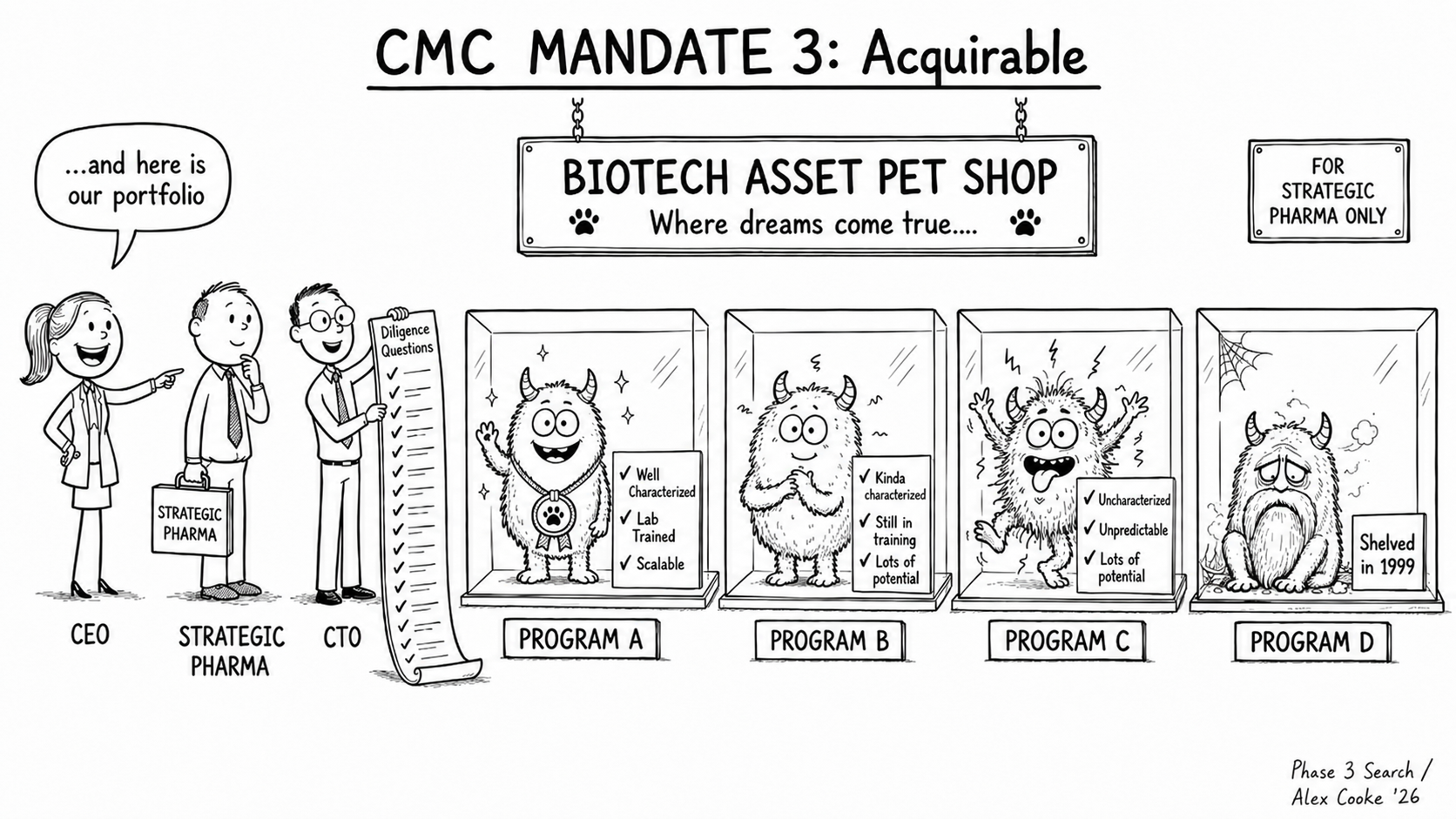
TL;DR: Acquirable is the third of the five CTO mandates. Put simply: whether an acquirer believes they understand your asset as well as you do. That belief is the thing they are buying, and a good buyer will pay full price for one of two versions of it. An asset they can absorb and run hands-off, with no key people to keep and no run of surprises to manage. Or one understood deeply enough to become a platform, not a one-off. Buyers are underwriting that belief earlier than ever: IQVIA put pre-Phase III deals at roughly 50% of biopharma M&A value in 2024, against a 19% four-year average. When they cannot get to the belief, they do not walk. The money just moves to the far side of a milestone, and you spend the next few years earning it back.
This is Part 3 of the CTO Mandate Framework series. Each piece covers one of the five things a technical leader is accountable for. Part 1 covered Possible, whether an asset can become a product at all. Part 2 covered Reproducible, whether you can make it the same way twice. This one covers Acquirable, whether the asset can prove its value to someone who did not build it. The Framework's other word for it is Investable.
Certain deals go wrong quietly. The data room is immaculate. Every document the buyer asked for, in the right folder, indexed. And the offer still lands with half the money hung on milestones you have to hit after the close. The company prepared exactly what it was told to prepare, folder by folder. It just prepared for the wrong test.
The CTO Mandate Framework names the discipline that prevents this. Acquirable. Or, if you prefer the other word for it, Investable. It means making the company diligence-survivable, so the record holds when a stranger reads it under a capital event. Survivable is the floor. The ceiling is where the money is.
What an acquirer is really buying
A diligence team takes your documents as read. That part is assumed. What they spend the next six weeks deciding is something else: whether they can understand your asset as well as you do. That belief is value, and everything in the data room is evidence for it, or against it.
The belief is worth paying for because it buys the acquirer one of two things. The first is continuity. They absorb the asset and it keeps earning, hands-off, without keeping the people who built it and without a run of surprises to manage. This is the beauty of GMP by system, not GMP by heroics: the line and the product still run whether or not the person who designed it is still in the building.
The second is optionality. The asset is understood well enough to become more than it is. It is a platform, not a one-off. This is a handle the buyer can turn themselves, and it is the part of the model that carries the upside. Both sets of value derive from a system that is written down and reproducible, not held in the heads of people.
The data room is a show home
So how does a buyer test a belief? They tap the walls. Think of the data room as a show home. Everything staged. Cushions plumped. Nobody actually living there. A good team walks straight past the styling and listens for the hollow bit. They pull the one deviation that resolved a little too neatly, the one wearing a fresh coat of paint. They ask why the protocol was designed that way, and who signed it off when the result could have come back ugly.
Then they do the thing that decides it. They ask the same question to three different people. And they listen for whether the answer holds.
Value is created by answer stability
The fastest read on whether an asset is genuinely understood is what the Framework calls answer stability. Ask the CTO why you chose your lead analytical method. Then ask the head of QA. Then the process development lead. In a company that has done the work, you get one answer with three views on it. In one that has not, you get three answers, and now the buyer knows the understanding lives in individual heads, not in the company.
That single finding breaks both halves of the value at once. Understanding that lives in heads cannot run hands-off; it leaves when the head does. And it cannot become a platform, because a platform is understanding you can hand to someone else and trust them to repeat. The lone process scientist who knows why a method changed is not an asset. He is a dependency. If a rival hires him away, the explanation walks out with him, and the buyer has watched that film before. A record that needs its original author in the room to make sense is a record a buyer marks down.
Acquirable is a board decision before it is a technical one
Here is where a governance framework parts company with a checklist. Acquirable is not a task you hand a technical leader eight weeks before the data room opens. It is a question of who owns the standard, and it is settled about two years earlier.
The Framework is specific. The mandate has to cover narrative completeness and answer stability, not just data-room documentation. Someone has to own the reconciliation between the story the company tells the market and the record that backs it. Someone has to hold the data-integrity line when the timeline would rather cut it. Someone has to have the authority to stop the company claiming something the record cannot support. Where nobody owns that, the mandate is unowned, however thick the eventual data room. That is a board decision. It costs nothing to make, and it quietly sets the size of the exit.
What being understood is worth
Aligning a company to Acquirable does not add value to the asset. It stops value leaking out of it at the one moment the leak is largest. When a buyer cannot get comfortable that they understand what they are buying, they price the doubt, as a lower number, or as money moved to the far side of a milestone so you carry the risk until the asset proves itself. In 2025 those contingent payments ran to more than a third of the size of the large deals that used them. That is real money, sitting on the wrong side of a line you drew two years earlier without knowing it.
And the exposure is growing, because buyers are committing earlier. IQVIA put pre-Phase III deals at roughly 50% of biopharma M&A value in 2024, against a 19% four-year average. Assets bought before the manufacturing has ever been read by a stranger. Through the buyer's lens, that is the whole game: they are paying real money for something they cannot yet fully verify, and everything they cannot verify, they discount or defer. Your job is to leave them less to guess at. The same read runs at every raise, not just the exit. A crossover investor tests Acquirable long before an acquirer opens the room.
The profile shifts here
Possible wanted a technical evaluator, someone whose judgment set the gate on the science. Reproducible wanted a systems architect. Acquirable asks for something different again: the leader who can make an outsider believe the asset is understood.
There is a tell I look for when I run CTO searches on this mandate. The strongest people on Acquirable do not walk you through the science they advanced. They tell you how they built a team that owned its own system and its own accountability, so the understanding did not depend on any one of them. They know the science and the filing requirements cold, and they can tell the whole story of how the asset came to be understood. The leader hired in from the outside never had the luxury of living that story. They had to piece it together, test it, prod it, build it, which is exactly what makes them both a special breed and the architect of the record the whole valuation will hang on.
Who Acquirable answers to
For the CEO, the premium cannot be claimed if the system is invisible. If every quarter the story and the record drift apart, and every standard is quietly deferred, then an Acquirable decision is being made without anyone calling it one. The bill arrives at the raise or the exit, and it resets the valuation and your negotiating position in the same move.
For the technical leader, owning Acquirable means building the understanding into the company, not into yourself. Writing the rationale so a hostile reviewer can follow it without an interview. Keeping the story and the record close enough that no diligence team can prise them apart. Turning the audit trail into the thing you hand a buyer to prove the asset, not a chore you tolerate. And asking for the authority to hold that line before the timeline asks you to trade it away. I know how that last one sounds. Asking for authority is uncomfortable. Ask anyway, because the alternative is owning the outcome without the power to shape it.
The Acquirable mandate is built in the two years before anyone opens the data room, because by the time the offer is on the table, the answer is already set. The offer is just telling you what it is.
Next Tuesday, Mandate 4: Scalable. The platform narrative, against the machine that actually has to make it. The full framework, all five mandates and where each becomes the one that decides the raise, is at the CTO Mandate Framework. Worth reading while you can still change the answer.
Sources and notes
- The framework: Phase 3 Search, the CTO Mandate Framework. Acquirable, which the Framework also calls Investable, is defined there as making the company diligence-survivable, so documentation, data integrity and supply chain withstand scrutiny under any capital event. The five mandates are simultaneous lenses on a radar chart, with one dominant per stage, not a sequence a company passes through. "Answer stability" and "narrative completeness" are the Framework's own terms, from its Information Asymmetry Reduction (Acquirable) section. The full framework is at ph3.bio/cto-mandate-framework.
- Deal structure: per a Jefferies analysis reported by BioPharma Dive (October 2025), contingent value rights, the payments a buyer holds back until an asset hits later milestones, averaged 37% of the total size of the large (over $500M) biotech deals that used them in 2025, up sharply from a few years earlier. CVRs price honest clinical risk as well as gaps in what a buyer can verify; both push consideration past the close.
- M&A mix: IQVIA data show pre-Phase III deals were approximately 50% of biopharma M&A value in 2024, against a roughly 19% four-year average, with acquirers moving earlier toward assets whose manufacturing has not yet been read under scrutiny.
- Framing: the continuity-and-optionality read, the show-home framing and the tell about the strongest technical leaders are my operating view, from the searches I have run; the links drawn between answer stability, documentation and valuation are associations a diligence team prices rather than a proven chain of cause. This piece is the mandate-ownership companion to two earlier Phase 3 articles, on the acquirer's diligence discount and on CMC as an exit multiplier.
If this is your discipline, let's talk.
Every engagement begins with a diagnostic — a structured read on the role and the company you are actually inheriting.
Start a diagnostic Our CTO & technical leadership practice →