
Can This Molecule Even Become a Product? (Mandate 1: Possible)
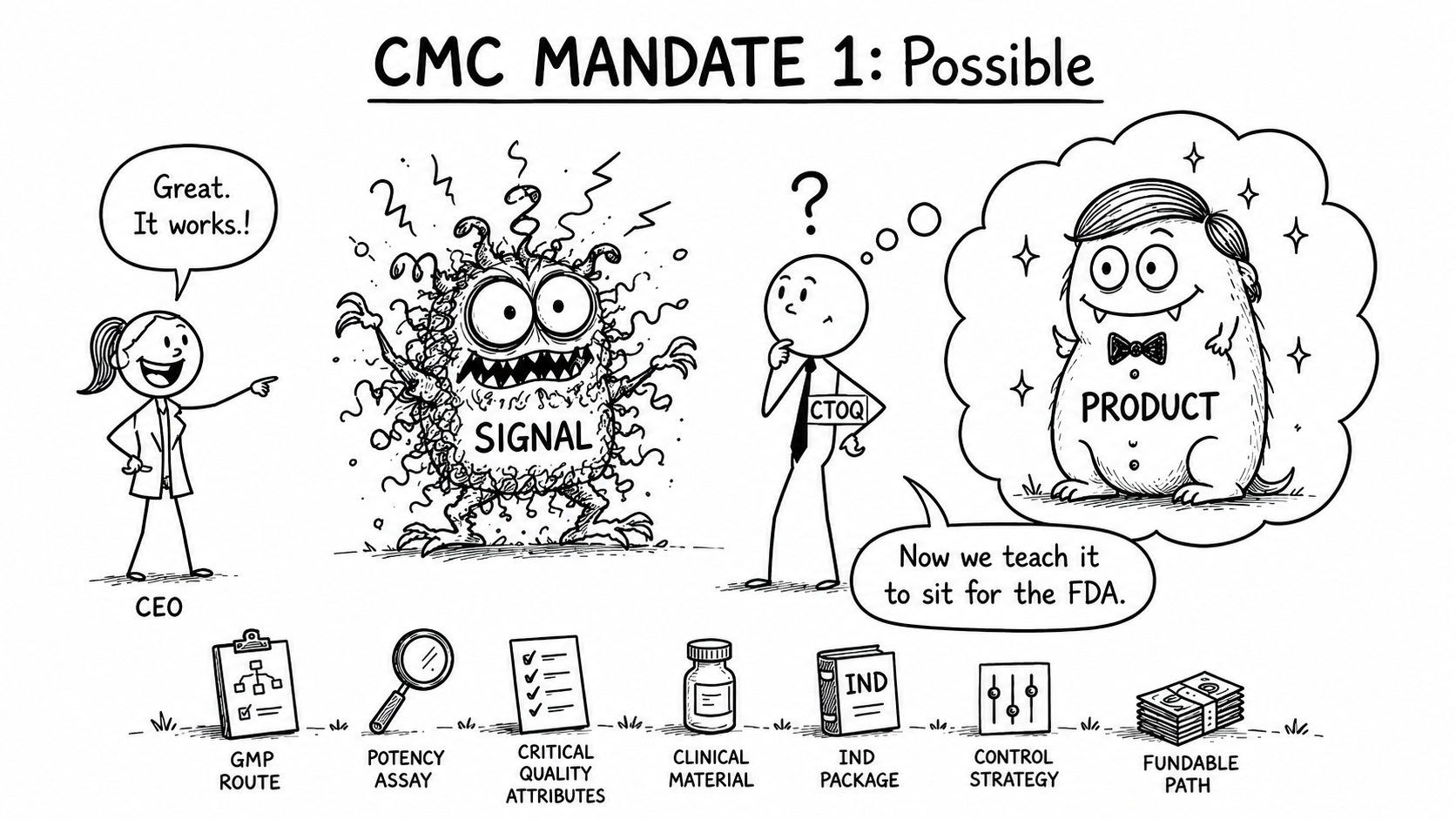
TL;DR: In the best available peer-reviewed data, 21% of cell and gene therapy clinical holds were attributed to CMC issues, with a mean duration of 8.4 months (Pietrusko et al., 2023). Those are programs where the science was fundable but the molecule was not yet a product: no measurable critical quality attributes, no regulator-legible manufacturing route. This is the first of the five CTO mandates, Possible, the work of turning a scientific asset into an investable, regulator-legible development position. Read on for what makes a molecule actually possible, why exciting programs stall here, and how to tell whether your technical leader owns this mandate.
This is Part 1 of a series on the CTO Mandate, one piece for each of the five things a technical leader is accountable for, taken one at a time. We start where every program starts: Possible.
“The science is de-risked. We just need to manufacture it.”
Every technical leader in biopharma has heard some version of that sentence, usually from someone who means it as reassurance. It is worth slowing down on, because the word “just” is carrying an enormous amount of weight. The first mandate of a CTO is to know exactly how much.
What Possible actually means
Possible is the first of the five mandates a technical leader carries, and it is the one most often assumed rather than checked. It means turning a scientific asset into an investable, regulator-legible development position. Not a molecule that works in a model. A molecule that can be made, measured, and defended well enough that a regulator will let it into humans and an investor will fund the next stage.
Four things have to be true for that. There has to be a manufacturing route that can plausibly reach GMP, a way to make clinical-grade material at all, not just bench material. There have to be analytical methods that can measure the critical quality attributes, the specific properties that determine whether the product is safe and active, because you cannot control what you cannot measure. There has to be a development path a regulator will read as legible: a CMC package an IND reviewer accepts. And the whole thing has to be investable: the manufacturing story cannot be the reason the next round prices you down or walks away.
When all four are true, the molecule is possible. When one of them is missing, you have a science project that looks like a company.
Why exciting programs stall here
The trap is that scientific signal and manufacturability are not the same axis, and in the modalities generating the most excitement they are often pulling in different directions. A gene therapy with a beautiful preclinical package can be, at the same moment, a program with no validated potency assay and no route to reproducible vector production. The science is real. The product is not yet possible.
The regulator sees this before the market does. CMC deficiencies at the IND stage do not produce a polite request for more data; they produce clinical holds. In the best available peer-reviewed data, 21% of cell and gene therapy clinical holds were CMC-attributed, with a mean duration of 8.4 months (Pietrusko et al., 2023). Eight months is not a rounding error on a runway. In a company burning cash against a fixed cash-out date, it can be the whole game. And the root cause is rarely the biology. It is that the molecule was advanced before it was possible, before anyone could measure what mattered or make it the same way twice.
The mandate is translation
This is why Possible is a translation mandate before it is a manufacturing one. The CTO’s job at this stage is to make the molecule legible to two audiences at once: the regulator, who needs to see control, and the investor, who needs to see a fundable path. The same CMC facts have to be true and have to be told in two registers. A leader who can run a process but cannot translate it into a regulator-legible, fundable position has not yet delivered Possible.
It also does not happen in isolation from the mandates that follow. The five mandates are simultaneous, not a sequence you pass through. At any stage one is dominant, but the others are already live. Claiming Possible while setting reproducibility aside does not hold, because a molecule you can make exactly once is not one a regulator will build a development path around. Possible is dominant at the earliest stage. It is never alone.
The three readers of Possible
Possible does three jobs for three people, and each one reads it differently.
For the CEO, Possible is the line between a fundable company and a science project. Your investors are pricing the CMC path whether or not you are presenting it, and a molecule that is not yet possible shows up as a discount, a smaller round, or a pass. Delivering Possible is what lets the science get the valuation the data would otherwise earn.
For the technical leader, this is your first accountability, and it is a translation job as much as a technical one. If you cannot make the molecule legible to a regulator and to an investor, the science does not get the chance to matter. This is the stage where the CTO earns the right to be believed later.
For the Head of Talent, the stage sets the profile. Getting a molecule to Possible (analytical method development, early regulatory strategy, modality-specific process design) calls for a different leader than running a commercial network. Briefing the search for the scale operator when the mandate is translation is one of the more expensive hiring mistakes at this stage, and one of the slowest to detect, because the gap only shows up at the first regulatory interaction. That calibration, mandate before profile, is how we open every biotech CTO search.
How to assess for Possible in a search
For a Head of Talent building the brief, here is how the Possible mandate shows up in an interview.
Signals to listen for
- The candidate can name the critical quality attributes for your modality and describe how they would measure them at this stage, not only at commercial.
- They have taken at least one program from research into IND with a CMC package that cleared, and can describe what the regulator pushed back on.
- They talk about the regulator and the investor as two audiences for the same CMC story.
Red flags
- CMC is described purely as scale-up and operations, with little to say about analytical method development or early comparability.
- They cannot name what would make your modality un-fundable from a CMC point of view.
- Every example is an established platform they inherited; nothing was built into a regulator-legible position from scratch.
Every program starts here
Before reproducible, before scalable, before a diligence team ever opens the data room, someone has to make the molecule possible: measurable, makeable, regulator-legible, fundable. It is the quietest of the five mandates and the one whose absence is most often discovered late, in a clinical hold the biology never earned.
Part 2 in this series takes up Mandate 2, Reproducible: from “it worked once” to “it works every time.” Possible is the first of the five mandates set out in the CTO Mandate Framework, where each one becomes the mandate that decides the raise.
If this is your discipline, let's talk.
Every engagement begins with a diagnostic — a structured read on the role and the company you are actually inheriting.
Start a diagnostic Our CTO & technical leadership practice →