
A Platform Is a Claim. The Machine Makes It True. (Mandate 4: Scalable)
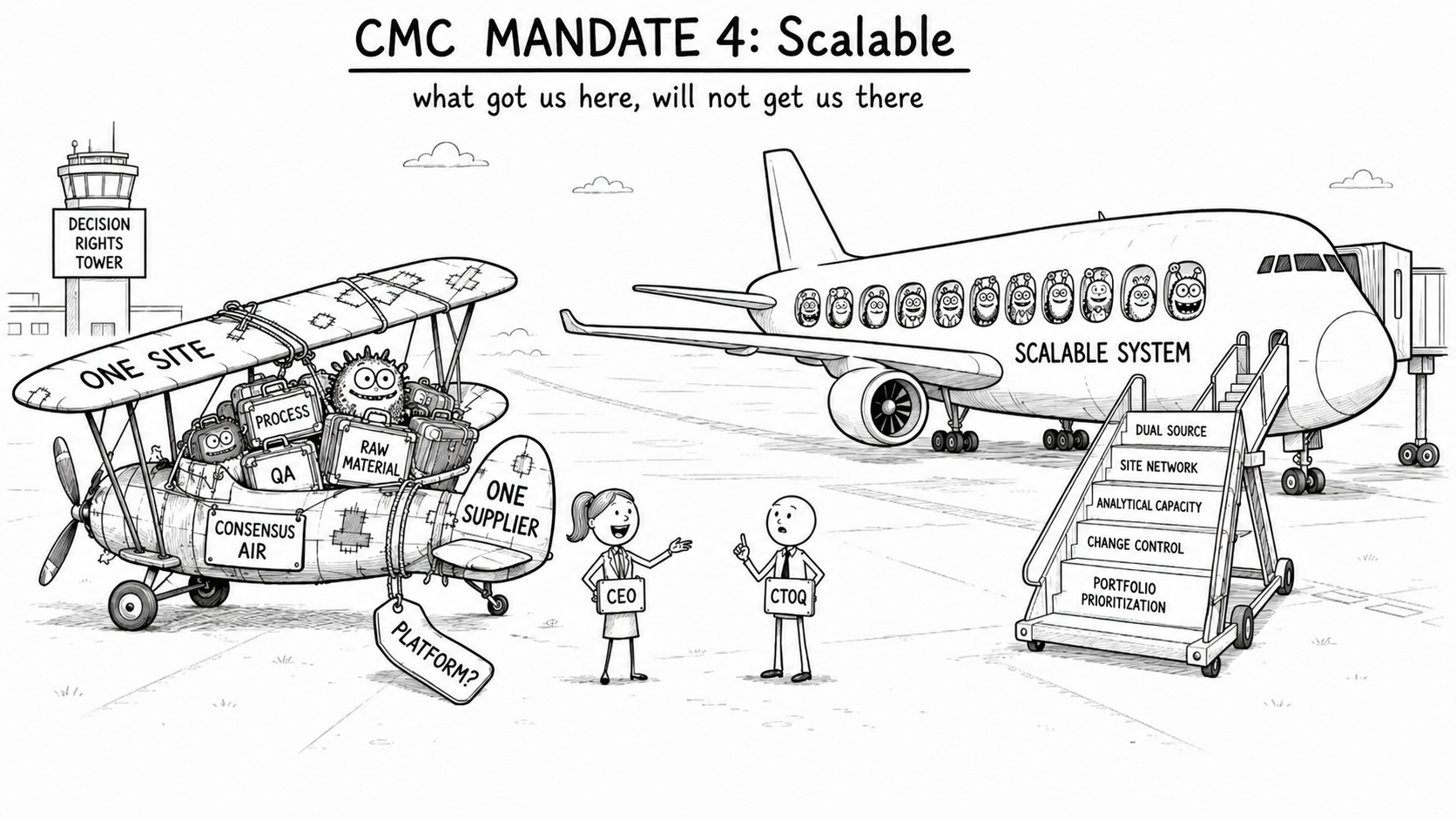
TL;DR: Scalable is the fourth CTO mandate, and it is where a company stops being a set of expedient decisions and becomes an enterprise system. The Framework defines it as building the operational machine, so processes are portable from bench to commercial scale and the platform supports multiple programmes without collapse. In practice it is the stage that introduces supplier resilience, resource prioritisation and redundancy across the whole operational continuum, and re-architects the early calls that could hamstring the company: single source becomes dual source, and consensus gives way to the DAI decision model. It matters because 85% of small biopharma outsource API and 77% finished dose (William Blair, 2024), so the machine you are building runs mostly through other people’s buildings.
Every biotech starts as a pile of decisions made quickly, by the same handful of people, because speed was the only thing that mattered.
One supplier, because qualifying a second cost money you did not have. One site. One process, locked because the IND clock was running. Consensus in the room, because the room was small enough to fit.
Scalable is the mandate where all of that has to become a system. And the decisions that got you here are the ones most likely to hold you back.
What Scalable actually builds
The Framework defines Scalable as building the operational machine: processes that travel from bench to commercial scale, and a platform that carries more than one programme without collapse. In practice that means controlled change, comparability, analytical bandwidth that grows with the pipeline, and supplier resilience. Moderna’s pre-IPO filing is the cleanest public example, describing a modular facility that integrates raw materials through to filled vials, an operating system, not just a molecule.
A scientific platform is a claim. An operating machine is what makes the claim true, program after program, at volume. The gap between the two is, in the Framework’s own words, one of the most underappreciated sources of value destruction in biopharma.
The early decisions that come home
Most of what Scalable fixes was decided years earlier, cheaply, by people who could not guarantee that they were making it permanent. The single-source supplier that was fine for one programme now gates the whole pipeline. The site chosen for proximity now caps volume, and the process locked to hit the IND now has to prove it can travel.
Scalable is the mandate that re-architects those calls before they become the ceiling. Single source becomes dual/multi source. One site becomes a network. The question stops being whether you can make this batch and becomes whether the operation can carry every programme you have sold, at once, without one starving the next.
Supplier resilience, prioritisation, redundancy
Three disciplines the company has never needed before all arrive at this stage.
Supplier resilience is qualifying a new source before the first one fails, not after. Dual-sourcing costs money every quarter until the quarter it is the only reason you still have supply.
Resource prioritisation is the harder one. A multi-programme company cannot fund everything, so someone has to decide which programme gets the analytical slot, the campaign window, the scarce raw material. That is a portfolio decision wearing an operations costume. It also introduces the need for a “kill maze” to increase the chance of ROI from the asset engine.
Supply resilience across the operational continuum is the frame that holds both. The machine is only as strong as its most concentrated point, and as you add programmes those points multiply faster than anyone expects.
Consensus does not scale
Here is the governance change Scalable forces, and the one boards miss. A small company runs on consensus, because the room is small and the decisions are few. An enterprise cannot. When four programmes compete for one analytical group, consensus becomes the slowest and most expensive way to make a call, and the tie never breaks on its own.
It’s not just the operation that needs to change but the decision making behind it. Decision-making must move from consensus to something like the DAI model: a single Decision-maker who owns the call, the Advice-givers who bring the facts and the disagreement before it, and the Informed who get the outcome after. One person decides; the rest input, or are told. The Framework is blunt that a CTO without the decision rights their dominant mandate demands cannot fulfil it. At this stage, the right to prioritise, and to say no, is a key component of the job.
Through the investor’s lens
If I am the investor, I will pay a greater multiple for a platform, which has the promise of breadth. What I am really underwriting is the machine underneath it. Something that is largely hands off and self-sufficient will always achieve a better number than something that requires conversion or babysitting. The honest technical leader can put a number on the distance between the platform’s promise and the machine’s current reach.
Who Scalable answers to
For the CEO, the platform is a valuation multiplier only if the machine can eventually deliver it, and the machine is built out of decisions that feel expensive long before they look necessary. Fund the dual source and the decision authority early, or explain the shortage and the down round late.
For the technical leader, this is where you stop optimising a process and start architecting an enterprise. Owning Scalable means dual-sourcing the concentrated risk and holding the decision rights to prioritise the pipeline out loud. If your operation still runs on consensus and single sources, you have a project wearing a platform valuation. Who has run the machine, not just the process, is the first sort we make in a biotech CTO executive search.
If you own this mandate, the job is to name your two most concentrated single points of failure this quarter, one supplier and one decision that still runs by committee, and start building the redundancy for both because the cheapest fix is when the fix still looks optional.
Next Tuesday, Mandate 5: Durable, security of supply when the threat comes from outside. This is Part 4 of five. The full framework, with all five mandates, is at the CTO Mandate Framework.
Sources and notes
- Outsourcing: 85% of small biopharma outsource API and 77% outsource finished dose. Source: William Blair, 2024.
- Moderna: the modular, integrated-facility description is drawn from Moderna’s pre-IPO (S-1) filing.
- The Framework: Phase 3 Search, the CTO Mandate Framework. The Scalable definition (building the operational machine; portability from bench to commercial scale; multi-programme support), the “value destruction” framing, and the DAI decision model (Decision-maker, Advice-givers, Informed) are the Framework’s own. The five mandates are simultaneous lenses, one dominant per stage. The full framework is at ph3.bio/cto-mandate-framework.
If this is your discipline, let's talk.
Every engagement begins with a diagnostic — a structured read on the role and the company you are actually inheriting.
Start a diagnostic Our CTO & technical leadership practice →