
“We don’t want to be big pharma.”
I hear a version of that line in half of my scaling conversations. Usually from a founding team member, the CEO, or the leader of the Reproducible / Scaling team, someone I like. And usually about three to six months after their best people stopped sleeping.
TL;DR: Every scaling biotech hits the point where heroics stop covering the work. FDA found 62% of drug shortages trace to manufacturing and product quality problems, and that the market does not reward mature quality systems. The fix is structure, the right kind, built before the stretch, by someone who has actually built it before.
Watch the dough
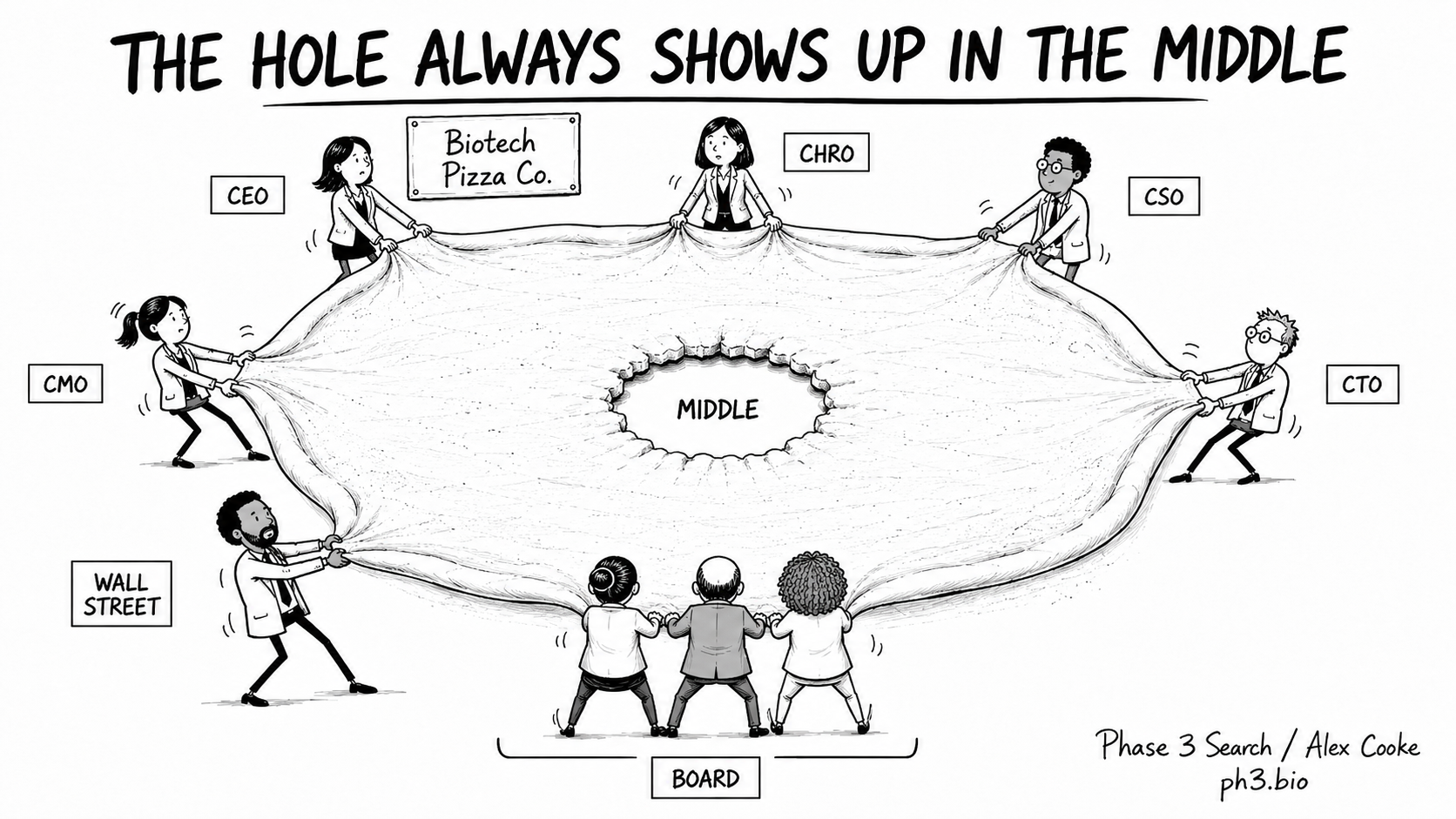
Anyone who has stretched pizza dough knows the danger of a hole. It normally appears at peak confidence, mid-stretch, mind already on the toppings.
The round thins as it stretches, and the hole shows up in the middle: the thinnest point, furthest from the supported edge. Materials scientists call it necking, and it is vicious because it feeds itself. Once one spot thins, stress piles onto that spot, which thins it further. Careful stretching does not save you.
Steel fails the same way. Pull a bar in a tensile test and it stretches evenly until one cross-section weakens, and from then on every extra bit of load piles into the neck. The mathematics of when a material tips into that runaway was worked out by Armand Considère in 1885, for bridges. What saves the bar is work hardening: the metal getting stronger exactly where it is being deformed hardest.
Cereal scientists later showed the same equation governs dough. Gluten is your work hardening, built before the stretch through kneading and rest. Structural engineers and bakers solved the same problem a century apart, which I find oddly reassuring.
Structure is the gluten.
And before the gluten-free readers object: celiac bakers have solved this too. Swap in psyllium husk and the right blend of flours and you get a different network doing the same job, holding the gas, carrying the stretch. The function is what matters, and there is more than one way to supply it. Fractional leaders and borrowed platform systems are the psyllium of a scaling biotech.
A scaling biotech is the dough. The middle is easy to name: the tech transfer that lives in one person’s head, the batch record held together by memory, the director layer turning strategy into batches, two commercial products becoming ten. The stretch is where the stress concentrates, and the hole appears shortly afterward.
The beep test your team is running
Meanwhile the pace keeps rising. If you went to school in the UK or Australia you know the beep test: twenty meters, a recorded beep, the pace climbs every minute, and there is no finish line. The test ends when you break. You are scored on when that happens. You are scored on survival.
A company without structure runs the corporate version, and occupational psychology has measured the result: exhaustion tracks demands rising against resources that stay fixed. The WHO defines burnout as “chronic workplace stress that has not been successfully managed.” The operative word is managed. Burnout at this inflection is a design outcome.
The fear deserves respect
Nobody starts a biotech to write SOPs.
And the fear of big-company drag has numbers behind it: Hamel and Zanini reckon excess bureaucracy costs the US economy more than $3 trillion a year. Everyone on your team has worked somewhere the change-control system existed mainly to slow down change. The fear is earned.
But the fear names the wrong enemy. A 1996 paper in Administrative Science Quarterly split structure into two species. Coercive procedures exist to extract compliance. Enabling procedures work like organizational memory, written so the people using them can see the logic and improve the process. Your team fears the first kind. The company needs the second. Same word, different animal.
The kitchen agrees, by the way: over-worked dough goes slack, because the network itself breaks down. Over-processing destroys the structure it was meant to build.
The structure inflection point is the stage at which a company’s work outgrows informal, person-carried coordination. Knowledge has to move out of heads and into systems: processes that are written down, decisions that can be reconstructed without the people who made them. Companies that cross it deliberately keep their speed. Companies that refuse it burn out their best people, and the organization tears at its least supported point: the middle.
The timing evidence is lopsided. In Startup Genome’s study of some 3,200 high-growth startups, 70% scaled one part of the company out of sync with the rest, and 93% of those never broke $100k in monthly revenue. Greiner wrote the underlying law in Harvard Business Review fifty years ago: “Management practices that work well in one phase may bring on a crisis in another.”
Hire the builder
So the middle needs structure to carry the weight. The question is who makes it?
Forgive me for being blunt, but this is where most boards buy the wrong CV.
Plenty of executives have operated inside a mature quality system. Far fewer have built one from bare walls. The first can describe the finished system beautifully. The second knows what to build first and what can safely wait until the next phase. When you hire big-company pedigree into a scaling company, you are often hiring someone who inherited structure. Whereas you need the person who knows how to create the blueprint, pour the foundation, route the utilities, build the walls, make sure there’s transparency, and stick a roof on it.
The interview question that separates them is short: what exists because you built it? Then listen for whether the answer is a system that survived their departure, or a seat they held in someone else’s.
Timing matters as much as the person. Hockey players are taught to skate to where the puck will be. Soccer is sharper still: you make the run before the ball comes, and you trust the cross to arrive. Relay runners pass the baton after the receiver has already set off. Hiring the builder feels exactly like that, because you are committing headcount to a stage you have not reached yet. Churchill and Lewis wrote it in Harvard Business Review in 1983: the systems must be acquired somewhat in advance of the growth stage. Stanford’s study of roughly 200 startups found that companies which retrofitted their organizational blueprint later paid for it in turnover and performance.
The run has to be made early, and it feels wrong every time. But if you wait too long, your speed will be lost in transition.
The receipts
For CMC leaders none of this is optional philosophy. ICH Q10 expects defined roles and an independent quality unit, in a system sized to the company, which retires both excuses at once: “we’re too small for systems” and “we need Pfizer’s QMS by Friday.”
FDA has gone further and built a maturity model: its Quality Management Maturity program scores establishments on practice areas including knowledge management. Its shortage analysis found 62% of shortages traced to manufacturing or product quality problems, with a named root cause that the market does not reward mature quality systems. If the market will not pay for maturity, the board has to choose it on purpose.
And in Jefferies’ read of the complete response letters FDA has now published, more than half cited manufacturing concerns. Wall Street can read your middle even when your board cannot.
Five questions for the next board meeting
When does the process lock, and who owns supply the moment it does? Whose head does the tech transfer live in? What has your quality leader actually built, and did it survive them leaving? Who governs what asset moves, and when: is that driven by what’s discovered, by what commercial sees as opportunity, by what’s manufacturable at scale, or by all of these at once? And if the pace steps up next quarter, what tears first?
If two answers come back as a person’s name rather than a system, the beep just got louder, and you know you’re running the race.
The close
Running the beep test is part of biotech life. The trick is finding the people who bring enough structure to support the middle, just enough to reach the next milestone ahead of the beep.
If you are somewhere between the science that got funded and the supply that needs to get filled, take the five questions into your next leadership meeting. If your answers come back as names, come talk to me before the pace goes up again.
Phase 3 Search was built to stop the burn and help you support the middle, before the hole arrives.
For anyone wanting a gluten-free Neapolitan crust recipe, please shoot me a DM.
— Alex
Sources and notes
- Considère A (1885): the plastic-instability (necking) criterion, derived for structural engineering; work hardening suppresses necking in tensile testing (University of Cambridge, DoITPoMS, Mechanical Testing of Metals). Applied to dough by Dobraszczyk BJ, Roberts CA (1994), J Cereal Sci 20(3):265-274; strain hardening as the stabilizing property: van Vliet T et al. (1992), J Texture Studies 23(4); Sroan BS, Bean SR, MacRitchie F (2009), J Cereal Sci.
- Psyllium as a gluten substitute: “Psyllium as an improver in gluten-free breads: Effect on volume, crumb texture, moisture binding and staling kinetics,” LWT Food Science and Technology (2021); “Enhancing Gluten-Free Bread Production: Impact of Hydroxypropyl Methylcellulose, Psyllium Husk Fiber, and Xanthan Gum on Dough Characteristics and Bread Quality” (2024, open access). Psyllium’s gel network binds water, builds structure, and retains gas during proofing.
- Léger LA, Lambert J (1982), Eur J Appl Physiol 49(1):1-12; Léger LA, Mercier D, Gadoury C, Lambert J (1988), J Sports Sci 6(2):93-101. The 20-m multistage shuttle run: start 8.5 km/h, +0.5 km/h per minute, scored as the last stage attained.
- Demerouti E, Bakker AB, Nachreiner F, Schaufeli WB (2001), J Appl Psychol 86(3):499-512 (Job Demands-Resources model); Lesener T, Gusy B, Wolter C (2019), Work & Stress 33(1):76-103, meta-analysis of 74 longitudinal studies (exhaustion tracks demands).
- WHO, ICD-11 (2019): burnout defined as an occupational phenomenon resulting from “chronic workplace stress that has not been successfully managed.”
- Hamel G, Zanini M, “Excess Management Is Costing the U.S. $3 Trillion Per Year,” Harvard Business Review, September 2016. Their estimate, built on BLS 2014 manager counts and stated assumptions.
- Adler PS, Borys B (1996), “Two Types of Bureaucracy: Enabling and Coercive,” Administrative Science Quarterly 41(1):61-89.
- Startup Genome, “Why Startups Fail: Premature Scaling” (2011; v1.2 2012), n≈3,200 high-growth internet startups, cross-sectional and self-reported: 70% scaled prematurely on at least one dimension; 93% of premature scalers never exceeded $100k monthly revenue.
- Greiner LE, “Evolution and Revolution as Organizations Grow,” Harvard Business Review, July-August 1972; HBR Classic reissue, May-June 1998.
- Churchill NC, Lewis VL, “The Five Stages of Small Business Growth,” Harvard Business Review, May-June 1983: systems “must be acquired somewhat in advance of the growth stage.”
- Baron JN, Hannan MT (2002), “Organizational Blueprints for Success in High-Tech Start-Ups,” California Management Review 44(3):8-36. Stanford Project on Emerging Companies, ~200 startups.
- ICH Q10 Pharmaceutical Quality System (2008), §2.1(b)(4) (defined roles; independent quality unit) and §1.7(c) (proportionality); 21 CFR 211.22(d) (written procedures).
- FDA CDER, “Quality Management Maturity: Essential for Stable U.S. Supply Chains of Quality Pharmaceuticals” (April 2022); Maguire J et al., AAPS Journal (2023) 25:14 (QMM pilots; scored practice areas include knowledge management).
- FDA Drug Shortages Task Force, “Drug Shortages: Root Causes and Potential Solutions” (2019, updated 2020): 62% of shortages 2013-2017 (163 drugs, 130 shortages) caused by manufacturing or product quality problems; Root Cause 2 on the market not rewarding mature quality systems.
- Jefferies analysis of FDA’s published complete response letters (reported by BioSpace, May 2026): more than half cited manufacturing concerns, most often failed facility inspections; 41% cited product quality.
If this is your discipline, let's talk.
Every engagement begins with a diagnostic — a structured read on the role and the company you are actually inheriting.
Start a diagnostic How we search →