
A Bit of a Rant: The AI Gold Rush Is Obsessed With the Wrong Metrics
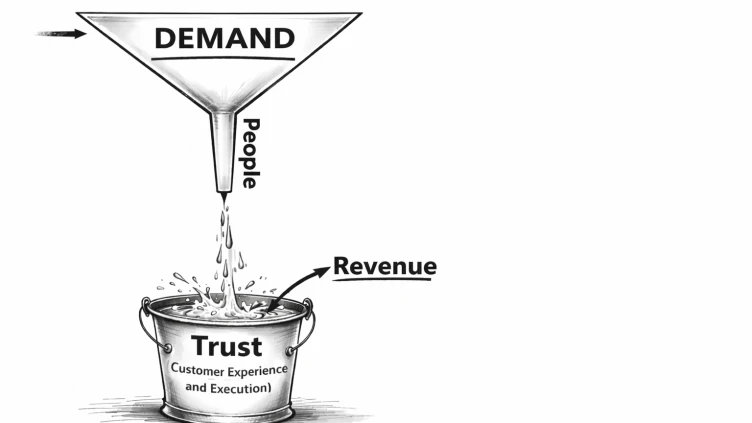
My LinkedIn feed right now is a parade of:
“Replaced 12 SDRs with Opus.”
“26 meetings booked in 3 hours.”
“Fully automated outbound. No humans required.”
It reads like we’ve cracked the code.
And maybe we have.
However, in my opinion, not the one that matters.
How I got here:
The celebration is almost always about volume.
Meetings booked. Messages sent. Sequences launched. Humans replaced.
It’s all throughput.
Very little about deals closed.
Very little about revenue quality.
Very little about whether those meetings convert into anything durable.
I've been in sales and led too many sales teams to not recognize that when pressure rises, the reflex is speed.
Add more automation. Increase cadence. Widen targeting. Turn up the dial.
More motion.
Rarely do organizations shift toward better thinking.
And so AI becomes gasoline poured onto whatever process already exists.
If the process is sharp, you get leverage.
If the process is mediocre, you get amplified mediocrity.
Reality
Booking a meeting is not the same as closing a deal.
And closing a deal is not the same as creating long-term value.
It’s much easier to screenshot a calendar than a clean revenue line.
It’s much easier to brag about booked calls than to discuss close rates, deal size, churn, or margin.
But those are the metrics that compound.
The arms race that is in motion
On one side: More AI-generated outbound. More personalization at scale. More content. More noise.
On the other side: Smarter spam filters. Inbox prioritization algorithms. AI systems that downgrade AI-written content. Buyers setting tighter personal filters on what they even see.
Volume rises.
Filtering rises.
Signal gets squeezed in the middle.
The inevitable outcome isn’t infinite scale.
It’s selective visibility.
And when that happens, brute-force volume stops working.
The Gap
If your AI is brilliant at writing, targeting, sequencing, and qualifying…
…but your team struggles to convert first meetings into second meetings…
or second meetings into signed contracts…
you’ve optimized the wrong layer.
You’ve scaled the top of the funnel without strengthening the middle or the bottom.
That’s not transformation.
That’s inflation.
Focus on the right things:
I’m not anti-AI.
I’m aggressively pro-AI.
But I think we’re pointing it at the right technology and the wrong target.
Until we have robots bartering with robots — at which point none of us have jobs anyway — business is still human.
Someone still has to:
Read the room.
Handle nuance.
Respond to hesitation.
Ask for the commitment.
Recover when it gets awkward.
That’s not going away.
So the smarter play isn’t replacing the human.
It’s upgrading the human.
AI is extraordinary at:
Analyzing call recordings for missed signals.
Identifying objection patterns across hundreds of deals.
Highlighting where top performers diverge from average ones.
Simulating tough buyer scenarios.
Providing real-time coaching prompts.
Training new hires faster than shadowing ever could.
That’s leverage.
Not volume.
The companies that win won’t be the ones who booked the most meetings.
They’ll be the ones who used AI to sharpen their people.
Because until robots negotiate with robots, humans still create value, generate revenue, and maintain relationships.
If you’re going to invest heavily in intelligence, make sure some of it lands on the people actually carrying the conversation.
Stop being obsessed with more.
Start being obsessed with better.
Volume scales activity.
Upgraded humans scale the only metrics that matter.
Client Value Created.
Client Trust Achieved
Revenue Generated.
Revenue Maintained.
If this is your discipline, let's talk.
Every engagement begins with a diagnostic — a structured read on the role and the company you are actually inheriting.
Start a diagnostic How we search →