
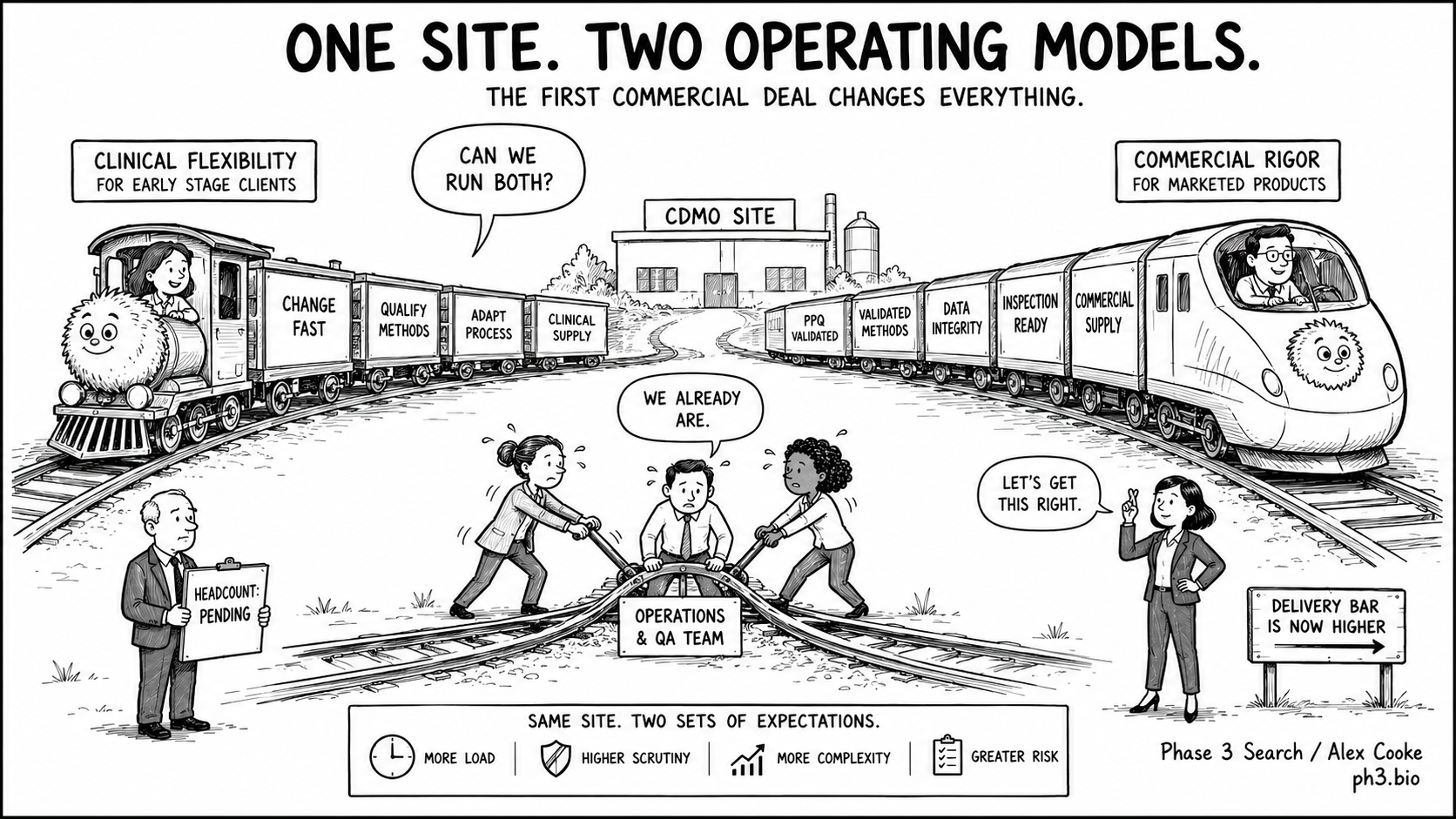
TL;DR: The most dangerous day at a CDMO is the one nobody treats as dangerous: the day the first big commercial deal lands. The delivery bar jumps, and the site has to run two operating models at once, the flexible clinical substrate the rest of the book still pays for, and the locked-down commercial rigor the new program demands. GMP by heroics has to become GMP by system before a pre-approval inspection tests which one you have. The stakes turn material: more than half of the FDA's 200-plus published Complete Response Letters cite manufacturing, and 41% cite product quality (Jefferies via BioSpace, May 2026). One contract site's findings triggered Complete Response Letters for three separate public sponsors who could do nothing about it.
This is part three of a five-part series on the CDMO industry. Part one covered the three-list selection mechanism and the math that inverted at the end of 2022; part two covered what the fragmentation headline hides. This one is about the day the model has to change.
The day I would most like to be in the room for at any CDMO is the one nobody treats as dangerous. It is the day the first big commercial deal lands. Whether it is a client you have carried since Phase 1 crossing into commercial, or a sponsor turning up with a program that will fill a suite for a decade, the site celebrates and somebody updates the revenue forecast. But the work is only just beginning. Because the job is about to change underneath everybody, and most firms do not redesign for it until something makes them.
The first commercial client means the delivery bar has moved higher, customer scrutiny increases, and complexity increases exponentially even before the signature is dry.
The burden is heavier
Let's start with the easy part. Load. The commercial program needs a validated process locked under PPQ, methods validated rather than qualified, a data-integrity posture that survives an adversarial read, and inspection readiness that exists before anyone announces a date. That is easy. Logical. The challenge is that the rest of your book still needs the flexible substrate, because those clients are in the clinic and that is what they are paying you for. In fact, it is what you are known for.
So the commercial whale lands, and immediately the site has to run two operating models at once, and only one of them is on the org chart. Put the commercial program on the clinical substrate and FDA findings will arrive. Put the whole book on commercial rigor and the margin leaves. Most firms meet this about nine months in, when the QA group is quietly rationing the coffee to make it through an overtime shift, and the HR business partner is wondering whether the board will sanction headcount before the QA team flames out like a 4th of July firework.
The move from GMP by heroics to GMP by system
Heroics is a site where the right people know the right things and the work gets done because they happen to be standing there. Someone remembers why the method changed in 2023. Someone drives in on a Sunday. Clients love it, because heroics look like service, right up until the person who is the system, and has not seen their family in six months, takes a job in Basel.
A system is a site where the answer exists whether or not the person does. It is slower to build. It feels like bureaucracy the whole way up, but it is the only version of the site that survives somebody leaving.
Clinical stage forgives heroics. The product is still moving, a method can sit in qualification, a process gets refined campaign over campaign, and a deviation can be explained by whoever was standing there at the time. A pre-approval inspection (PAI) exists to work out which of the two you have. It reads the site's history as evidence of control, and asks you to reconstruct a decision without the people who made it in the room. If that decision was made at eleven at night in 2023 by someone who has since left for a competitor, the file has to speak on its own.
Conceptually, GMP by system makes sense, but moving to it feels uncomfortable, because the legacy site culture rewarded heroics. Stan saves the batch. Melissa made it happen at 11:49pm. When you take the need for those heroics away, people question whether the culture has changed and where they fit into the mission. Which means it becomes even more important to connect the operation to the result, the reward, and ultimately the patient.
The pressure is now material, in the legal sense of the word
Pressure of delivery goes with working at a CDMO, but with public or near-public clients, one mistake on a commercial batch can put you on the front page of a newspaper, and it is brutally difficult to rebuild a site's reputation. Bigger client whale, bigger stakes. Your client is a public company now, or about to be, and that program is most of what the market thinks they are worth. Your deviation is their disclosure. Your slipped batch is their earnings call. Your Form 483 is a line in their 10-K and a very bad morning for their CEO.
The numbers are not gentle. Of the more than 200 Complete Response Letters the FDA published starting in July 2025, covering applications from 2020 to 2024, a Jefferies analysis reported by BioSpace (May 2026) found more than half cite manufacturing and 41% cite product quality, well ahead of any clinical cause. When one lands, the buy side reprices the client's probability of approval from somewhere around 70% to 80% down to 10% to 40%. The median road back is 1.28 years. For a first-time launcher it runs two to four.
Bloomington is the version with the names in. The FDA inspected the Catalent Indiana site across June and July of 2025, found more than twenty deviations it had not properly investigated, and classified it Official Action Indicated in October, which is the regulator's way of saying an unacceptable state of compliance. Three listed sponsors then took Complete Response Letters off the back of one building's findings: Regeneron on odronextamab, Scholar Rock on apitegromab, and Incyte on Zynyz in first-line lung cancer.
Scholar Rock's own release said the letter was solely about observations at the site. Their efficacy data was fine. Their safety data was fine. Their drug substance manufacturer was fine. Not one of those companies could do a single thing about it. That is what your suite holds once the big deal lands: somebody's market capitalization, and the careers of the people who chose you.
The customer has to change too, and they did not ask to
Which brings us to the part almost nobody plans for. The client chose your flexibility. You said yes when the big shops said queue, you shaped the process around their molecule, you took the Sunday call. Now you have to start saying no to the same people, for their own protection, and it will not feel like protection. It will feel like you got worse.
"You used to be so responsive." That sentence, from a client you have carried for four years, is the sound of a relationship failing to make the transition.
Forgive me for being blunt, because this lands on people who have done nothing wrong. If you do not lead that conversation, you lose the client anyway, and not to a competitor. You lose them to their own board, or their Series C lead, or an acquirer's diligence, who will ask who is making this at commercial scale and will not love the answer.
So the customer experience has to alter deliberately, early, and out loud. The change control that took a phone call now takes a form, and you explain why before they hit it rather than after. What you flex on and what you will not flex on gets written down and shown to them. Their QA lives in your building more often, and you make that easy instead of defensive. The best at this start telling clients about problems earlier than is comfortable, because a surprise that reaches a public company late is far worse than a problem that reaches them early. Handled properly, none of that reads as a downgrade. It reads as a partner who understands whose name is on the filing, and one that embraced leveling up its service.
The essentials
The firms that get through this do a short list of unglamorous things, early. They stand up the commercial track before a client needs it, rather than converting the clinical one under deadline pressure with a filing date already public. They standardize ahead of demand. They put quality-systems and commercial-operations leadership in the chair before the first inspection rather than after the first finding. And they have the honest conversation with the client while it is still a choice rather than an explanation.
The third one is the one firms defer, and it costs the most. The leaders who build a CDMO to this point are commercial and operational athletes. They win trust and hold a fragmented book together by sheer force of personality, and that profile is exactly what the business needed to get here. It is a different leader from the one who has carried a product through validation and stood in front of an inspector, where the job turns on whether the file speaks when nobody does. That leader becomes not only the operational driver but also the closer for every new commercial client that walks through the site's door. Managing that succession, commercial athlete to validation architect, without losing the book is the brief we build CDMO leadership search around.
The part worth planning for
None of this is a surprise risk. It is visible the moment a clinical client's lead program starts to work, which makes it a planning problem, and planning problems reward whoever looks up first. "What got us here will not get us there" is the oldest line in scaling, and it is never more literal than on a CDMO floor the month after the big deal lands, where the thing that has to change is the exact thing that worked.
The industry is short of contract manufacturers that can carry a molecule from Phase 1 to the pharmacy without the client switching partners halfway across. Every sponsor I speak to would rather not make that switch. It costs them comparability work, months, and fresh regulatory risk on the asset that is now the entire company. They do it because their capital, or their board, makes them. So the prize for getting the transition from a development site to a commercial-product site right is the most valuable there is: you become the partner nobody has to leave.
GMP heroics built the company. GMP systems, built by those same heroes, are what will let it reach sustainable success, scale, and the reward of exit.
Sources and notes
- CRL figures: FDA CRL repository (more than 200 Complete Response Letters released starting July 2025, growing to roughly 350 by 2026): a Jefferies analysis (Andrew Tsai), reported by BioSpace in May 2026, found more than half cite manufacturing and 41% cite product quality, corroborated by Mizuho's Graig Suvannavejh. Separately, Dilek et al. (2026), Therapeutic Innovation and Regulatory Science, analyzed 43 novel therapeutics issued Complete Response Letters (2020 to 2024) and found 65% cited facility deficiencies and 51% cited CMC deficiencies, with a median of 1.28 years from CRL to eventual approval (two to four years typical for first-time launchers) and buy-side probability-of-approval repricing from 70-80% pre-CRL to 10-40% post-CRL; corroborated by Pharmaceutical Technology's analysis of the FDA release, and compiled in Phase 3 Search's CTO Mandate Framework.
- Catalent Indiana (Bloomington): FDA inspection June 23 to July 14, 2025; more than twenty inadequately investigated deviations; Official Action Indicated classification October 9, 2025; FDA Warning Letter to Catalent Indiana, LLC (718189) dated November 20, 2025. Resulting Complete Response Letters: Regeneron (odronextamab, July 2025), Scholar Rock (apitegromab, September 2025, stated by the company as solely related to observations at the fill-finish site and not to efficacy, safety, or the drug substance manufacturer), Incyte (Zynyz, first-line NSCLC). Sources: FDA warning letter database; Scholar Rock investor releases; Pharma Manufacturing; BioPharma Dive; FiercePharma.
- Framing: manufacturing-and-CRL links are presented as association rather than proven cause.
If this is your discipline, let's talk.
Every engagement begins with a diagnostic — a structured read on the role and the company you are actually inheriting.
Start a diagnostic Our CDMO search practice →