
The Mandate That Keeps You Out of the News (Mandate 5: Durable)
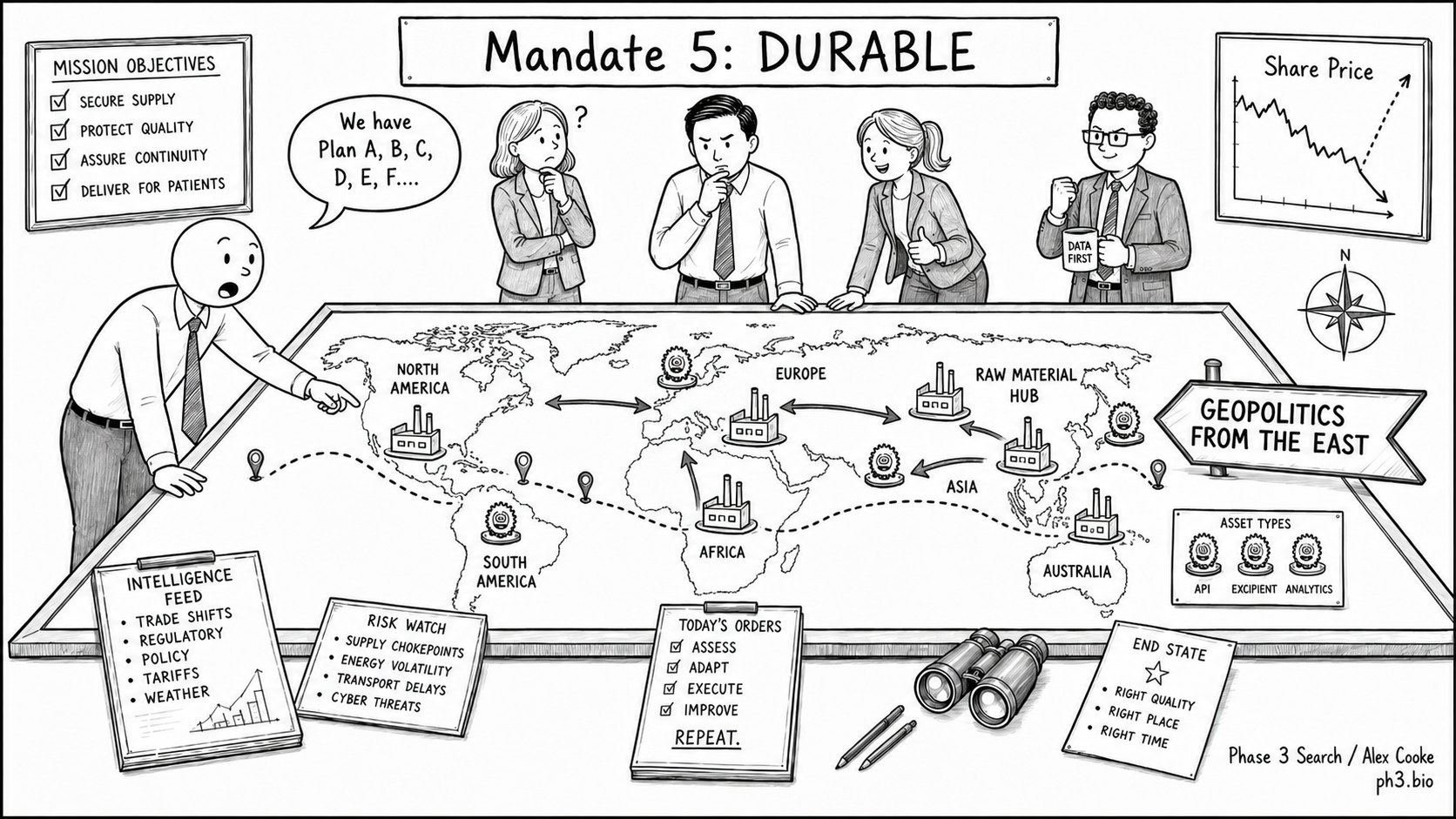
TL;DR: Durable is the fifth CTO mandate, and it is security of supply: anticipating and defending against the external shocks that can stop you making product, and, where you can, repositioning to take advantage of them. The Framework defines it as hardening enterprise performance under inspection, shortage, and geopolitical stress. It matters because your resilience mostly sits outside your walls: 85% of small biopharma outsource API and 77% finished dose (William Blair, 2024), and about 42% of US drug plants, roughly 2,000, are overdue for inspection with a queue behind them (Associated Press analysis of FDA data, 2024; US GAO, 2024). This is the mandate that answers to shareholders, and whose highest achievement is that nobody outside the company ever notices it working.
The best-run supply chain in biotech is the one you never read about.
That is the whole ambition of the fifth mandate. Not applause. Silence. No shortage notice, no recall in the trade press, no analyst asking why last quarter slipped because a plant in one country stopped shipping to another.
What durable actually defends
Durable is the mandate that keeps a company making product to specification when the threat comes from outside its own operation. A tariff or an export control that turns a supplier's country into a liability overnight. A regional health or political shift that reroutes demand or closes a border. A re-inspection with a harder investigator. A single node that a disaster or a policy change takes offline. The Framework's phrase for it is hardening enterprise performance under inspection, shortage and geopolitical stress: redundancy where it matters, and a supply chain designed to bend rather than break.
Supply is the plumbing of a drug company. Nobody thinks about it until it bursts, and when it bursts, it does so in public.
Anticipate, defend, and occasionally profit
Scalable built the machine. Durable keeps it running through conditions it did not choose.
Most of the work is defensive: mapping where supply concentrates by geography, and qualifying alternatives before a shock forces the issue, whilst holding inspection readiness as a permanent state rather than a fire drill booked the week before an audit.
The best operators do more than defend. A supply shock is also a supply opportunity. When a region becomes unreliable, the company that already qualified a second source in a stabler one does not merely survive, it takes the share of the competitors who did not. Geopolitical stress is a threat to the unprepared and an opening for the ready, and that asymmetry is where durability stops being a cost and starts being an edge.
Amgen is the cleanest example of the offensive version. During its 2014 drive to lift operating margins, the plant that got the headlines was the next-generation facility it opened in Singapore: modular, single-use, built in half the time, at roughly a quarter of the capital cost and a third of the operating expense of a conventional plant. Impressive engineering. But the more durable lever sat underneath the building, not inside it.
Amgen ran that operation into a Singapore tax incentive grant that stretches to 2034, against a US corporate rate several times higher. The clever facility saved capital once. The jurisdiction compounds every year the grant is live. The headline was the technology. The margin was the geography.
That is the Durable mandate playing offence. Security of supply is the floor: qualify the second source and survive the shock. The ceiling is choosing where you operate so the map itself works in your favour, on tax, on stability, on distance from the shock everyone else is standing next to.
The shareholder's clock
By the time a company reaches this mandate, it usually answers to shareholders, and shareholders price surprises harshly. A drug shortage is not an operations problem to them. It is a revenue miss with a science-shaped cause, and a management team explaining, on a call, why the risk was not seen coming.
So the CFO's read on Durable is plain. Every single-source node and every un-inspected critical supplier is an unpriced liability sitting on the balance sheet, waiting for a quarter to land in.
The measure of success is silence
Here is the strange thing about this mandate. Done well, it is invisible. There is no headline for the shortage that did not happen, the inspection that passed without drama, the border closure the second source absorbed. The reward for durability is that the company stays out of the news, and the operation nobody is talking about is usually the one being run best.
That is also why it is the easiest mandate to underfund. The second site sits idle until the first is shut. The dual source costs money every quarter until the quarter it saves the franchise. I am conscious that is an association a board should price forward rather than a proven chain of cause. The companies that price it late tend to price it in a shortage.
Who Durable answers to
For the CEO, Durable protects the commercial franchise and the valuation through shocks you do not control. Its absence is a shortage that hands the market away, or a finding that resets the story the year after approval. A durable operation is what lets a company keep the value it spent four mandates building.
For the technical leader, Durable asks you to spend on security of supply the organisation cannot yet see the return on, and to see the external threat before it arrives. If your resilience depends on one supplier in one region and a readiness you assemble only when an inspection is booked, you have an operation that works right up until the world moves. Owning it means the redundancy and the readiness are built before the shock, and the geography is diversified before the headline.
The leaders that win in this mandate are those that have the ability to work cross functionally to anticipate threats, and turn defense into offensive moves that steal market share, improve operating margins and do so by manipulating the pulleys and levers that exist both inside and outside of their primary functions. Part politician, part master strategist, part operating cost whisperer, and often with a future-looking crystal ball, this role requires as much skill outside of the function as it does in it.
If you would like to read more about this mandate, the full CTO Mandate Framework is available on the Phase 3 Search website. Please feel free to grab a copy and send your feedback to the team. And when the mandate on the table is a hire rather than a read, that is the work of our CTO executive search practice.
Sources and notes
Framework definition of Durable, hardening enterprise performance under inspection, shortage and geopolitical stress, with redundancy, is from Phase 3 Search, The CTO Mandate Framework (whitepaper). The full framework is at ph3.bio/cto-mandate-framework/.
About 42% of US drug-manufacturing plants (roughly 2,000) overdue for a surveillance inspection, some for more than five years: Associated Press analysis of FDA data (2024); US Government Accountability Office reporting on FDA drug-inspection oversight (2024).
85% of small biopharma outsource API and 77% outsource finished dose: William Blair biopharma outsourcing analysis (2024), as cited in Phase 3 Search's earlier articles.
Amgen example: Amgen announced a 2014 transformation targeting up to $1.5 billion in annual savings and a roughly 23% cut in its facilities footprint, with adjusted operating margin guided to 52-55% by 2018 (Amgen investor materials, 2014; FiercePharma, 2014). Its next-generation Singapore biomanufacturing plant, completed November 2014 (about SG$200 million), was built in roughly half the time at about a quarter of the capital cost and a third of the operating expense of a conventional facility (Amgen; FiercePharma; Manufacturing Chemist, 2014). Amgen discloses that its Singapore operations are covered by a tax incentive grant through 2034 (Amgen, Global Tax Strategy and SEC filings). Alex refers to the transformation as the "Full Potential" programme; the public restructuring figures above are what is documented. The reading that the tax jurisdiction, rather than the manufacturing technology, was the more durable lever is my analytical view, not a single sourced statistic.
Framing: the security-of-supply, shareholder-clock and out-of-the-news reads are my operating view; the link from durability to valuation is an association a board should price forward, not a proven chain of cause.
If this is your discipline, let's talk.
Every engagement begins with a diagnostic — a structured read on the role and the company you are actually inheriting.
Start a diagnostic Our CTO & technical leadership practice →