
CDMO Capstone: Whose Head Does the Answer Live In?
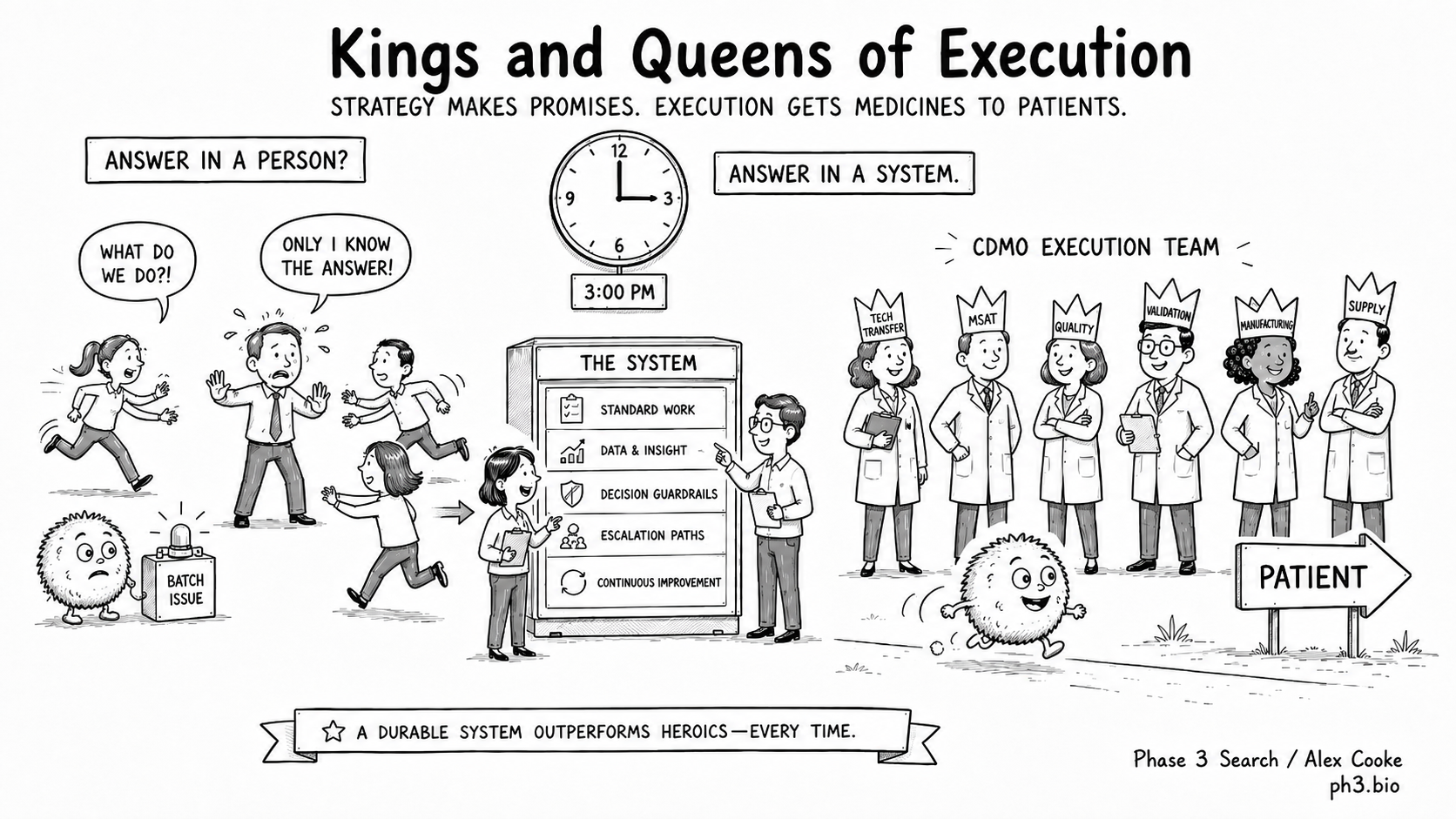
TL;DR: A medicine only reaches a patient because someone makes it, and in the outsourced era that someone is increasingly a CDMO. This industry now carries a large part of the biopharma mission on its shoulders, under a pressure the rest of the chain never feels. Across five parts I have tried to do it justice: what strains it, what it forges in the people who work in it, and how a sponsor tells a resilient partner from a fragile one. It comes down to one question, a ten-question diagnostic you can run before you sign, and an honest map of the nine things this industry cannot yet measure about itself. The prime directive never moves, a medicine reaching the patient waiting for it, and the CDMO industry is how, more and more, that actually happens.
The point of all of this
Before anything else, the reason this series exists. A medicine is only real when it reaches the person waiting for it. The science, the capital, the strategy, all of it is a promise until someone makes the product and gets it out the door.
For a growing share of the industry, that someone is a CDMO. Of the therapies the FDA approved in 2024, seventy-four percent had their active ingredient made by another company, and eighty-five percent for the small innovators who carry most of the pipeline. The outsourced era simply moved a large part of the mission to the contract side, and the contract side has carried it.
So read this as what it is: a close read of an industry I think is vital and badly under-credited, written so the sponsors who lean on it can pick the right partner, and the leaders inside it can build something that lasts. It is not a takedown of a failing industry. The prime directive does not shift when work moves to a CDMO; it is served there, batch by batch, by people the rest of us rarely see.
The question
Here is the whole series in one sentence. When something goes wrong on your programme at three in the afternoon, does the answer come out of a system, or out of a person?
Everything else, the fragmentation arithmetic, the modality gradient, the capital structure, the statute, the concentration, the valuation multiple, is a way of asking that question with a different instrument.
It sounds like a quality question. It is really the question that decides what your company is worth, because it decides the variance around the date in the model. And variance around a date shows up in exactly one place in a valuation: the discount rate.
Five ways the answer goes missing
Part one was the arithmetic. Ten clients with four programmes each became forty clients with one programme each: the same programme count, several times the complexity, and no repetition anywhere. A CDMO is a repetition business, and margin comes from running the same operation often enough that it stops surprising you. Fragmentation starves the system of the repetition it needs to form in the first place.
Part two was about where that lands hardest, and what the headline numbers hide. Modality decides how much of the work is standard. Capital structure decides what a CDMO is permitted to refuse. Geography has been reshuffled by a statute that is now law. None of it shows up in a capacity figure, which is why the number everyone quotes answers the wrong question.
Part three was the moment the regulator stops accepting a person as the answer. In clinical supply you can carry the deviation history for your busiest suite in the head of your best scientist, and it works, until it does not. As a programme moves toward commercial the standard rises to a validated, inspectable system, and the firm that grew on the brilliance of individuals discovers it has excellent outcomes and no evidence.
Part four was about the people who do this transfer for a living. The deepest hands-on manufacturing experience now lives on the contract side, forged under a pressure the captive career never applies, and yet the same companies still write no CDMO background into the brief. The skill is built at a CDMO and almost nowhere else, and the industry is only starting to hire for it.
Part five was the mirror at the top of the market. Scale is real, and it buys what a boutique cannot, a genuine second site, a balance sheet that can bet on you like a venture investor. But scale does not remove your risk, it converts it. You become a position in a portfolio managed for the portfolio, oversubscribed against an attrition rate that may not arrive, bumped when a larger client signs, repriced when new leadership resets the margin. And the deepest failure at scale is not an absent system but a system that has learned to produce the answer rather than to find it, which is what a data-integrity finding actually is.
Fragmentation stops the system from forming. Scale can teach it to look correct. The failure modes are opposite and the disease is identical: the firm's competence is not where the firm believes it is. Underneath all five parts sat the same question, wearing a different costume each time. When something goes wrong on your programme at three in the afternoon, does the answer come out of a system, or out of a person?
The nine holes
I set out to anchor this series in published evidence, and enforced a rule: peer-reviewed journals, regulator and government primary documents, company filings, or named institutional research with a document you can open. Trade press only as a signpost. Social platforms never. The rule cost me more than I expected. Here is what this industry argues about constantly and cannot measure.
- There is no published CDMO capacity utilisation rate. Not one. No annual report reviewed for this series discloses a numeric suite or plant utilisation figure, and every industry-average number in circulation traces to search-optimised content.
- There is no published failure rate for process performance qualification or continued process verification, the single most consequential gate between clinical and commercial manufacturing.
- There is no published tech-transfer success or failure rate, and no published comparability-failure rate on transfer between sites.
- There is no published cost of a rejected commercial batch, an out-of-specification investigation, or a deviation. The figures you have seen are consultancy marketing without disclosed method.
- There is no published pre-approval inspection failure rate. The FDA describes the withhold mechanism and publishes no outcome rate against it.
- There is no published share of mid-size CDMOs under financial-sponsor ownership. The long tail is uncounted by ownership type.
- There is no independent, size-stratified dataset comparing CDMO inspection outcomes. Every claim that larger means cleaner is a self-report, and the public Form 483 record spans the whole size distribution.
- There is no survey in any tier that measures trust or relationship as a driver of a CDMO award. The ranked criteria are on-time delivery, regulatory record, capability, capacity, scale. I had been arguing otherwise for years.
- There is no established cost of a senior technical mis-hire in biopharma. The most rigorous traceable source excluded executives from its median because they skewed it, and rests on case studies two decades old.
Nine holes, in an industry that manufactures medicine to six-sigma tolerances and cannot tell you how full its own suites are. I do not think that is an accident. Each hole sits where the industry has never been made to measure itself, and in a couple of places where it would rather not look too hard. Which has a practical consequence: the CDMO cannot benchmark itself for you, and neither can anyone else. You have to ask.
The diagnostic
You can run this from outside the building, in an afternoon, before you sign anything. Ten questions. None needs a consultant, and none is about capacity.
- How many clients does this site run, and how many programmes per client?
- What is the median age of an open item in the change-control backlog? The age, not the count.
- How many requisitions are open in QA, validation and analytical, and how long has the average one been open?
- Where does the deviation history for your busiest suite live, in a system, or in a person?
- If your most experienced process scientist did not come to work for three months, which programmes would slip, and how would you know before I did?
- When did you last run a mock inspection against a programme not already under inspection pressure?
- Has anyone in this firm ever declined a programme on readiness grounds? Name them, and tell me what happened to them.
- Which other client's methods sit next to mine in the analytical group's workload, and which deviations on adjacent programmes would force a pause on mine?
- What share of this site's revenue comes from your largest customer, and how has it moved in two years?
- When your quality unit and your site P&L disagree, who decides? Give me an example from the last twelve months.
Two of those are load-bearing and the rest are corroboration. Question eight is the one nobody prepares for; if the site head answers it from memory, that is the diagnosis rather than reassurance, because it means the interaction between your programme and the one in the next suite lives in a person rather than in a system that would surface it whether or not that person was in the room. Question ten cannot be faked. It has exactly two answers: a specific story, with a name and a date in it, or silence dressed as a sentence about how quality and operations work as partners. The second answer is also an answer.
The leader this requires
There is a pattern in every professional firm I have watched cross this line, and it is not specific to manufacturing. Early on, revenue depends on one or two people. It comes from relationships and hustle, and the process is whatever the closer does. Then the firm grows, and the same shape appears on the operating side: throughput depends on the few who hold the knowledge in their heads. The ceiling arrives when those people max out personally. Nothing multiplies them and there is no one to take the handoff, and the firm plateaus at the throughput of its best individuals.
The instinct is to add people. What a firm actually needs is a different kind of leader. Someone who builds the operating system rather than working inside it, who writes down what the senior scientist knows while the senior scientist still enjoys being asked, and who separates the quality unit from operations before there is a reason on the front page to wish they had. That last act is the whole thing. Everyone in the building watches what happens to the person who says no. If they are overruled, the organisation learns that readiness is decorative, and the lesson holds for years, long after the person who overruled them has moved on.
Hiring ahead of that curve is how a firm accelerates. Hiring behind it is how a firm stalls, and then explains the stall as a market condition. The uncomfortable corollary is that the leader who got you here is frequently not the leader who takes you there, and both of you usually know it before either says so.
What this is worth, in the language a board uses
Fully integrated CDMOs trade at roughly 19.5 times forward EBITDA; sub-scale, niche CDMOs at about 14.0, with a five-year gap that runs wider still. Some of that spread is scale. A material part of it is something else: the market's estimate of how much of a firm's competence is documented and inspectable, against how much of it walks out of the building at six in the evening.
The same logic runs through your own cap table. When an investor prices your programme, they are pricing the probability of an approvable filing on a date. Every dependency that lives in an individual rather than in a system is an unpriced probability of slippage, and it never shows up as a line item until the date moves. Among novel therapeutics that received a Complete Response Letter and were later approved, the median delay ran well over a year, with manufacturing-facility deficiencies cited in a majority of those letters. A CMC leader who can walk a board through the ten questions above, and answer them about their own CDMO, is doing more than administering quality. They are removing variance from the model that decides what the company is worth. That is a different job than the one most of them were hired against, and it is why the hire is so often made a year late.
Where we come in
Phase 3 Search places the leadership that carries this transition. On the CDMO side: heads of quality who have been inspected at commercial scale and have the standing to lose an argument with a site P&L and stay in post; MSAT leaders who have run tech transfer into a validated process rather than into a slide. On the sponsor side: the CMC leaders who can read a manufacturing partner from the inside and defend a programme's place in the queue. Sometimes the most useful thing we do is help a board work out whether the constraint is structure, capability or timing before any search begins, and occasionally the answer is that no hire is needed yet, which is a strange thing for a search firm to say and a good reason to trust the ones who say it.
One note on method, because it shaped everything above. Every load-bearing figure in this series comes from a peer-reviewed journal, a regulator or government document, a company filing, or named institutional research you can open and read. Where a number does not exist, I have said so rather than borrow one that sounded right. There are nine such places. I would rather publish the holes than paper over them; in an industry that gets audited for a living, it seems the least we can do.
The kings and queens of execution
A last word, to the people this series was really about. The CDMO industry has carried biopharma through the hardest financing years it has seen, on the shoulders of people who kept the answers in their heads because nobody built them a system. The skills they carry, running someone else's process under cost and survival pressure, defusing the failed batch nobody will ever hear about, converting chemistry onto equipment it was never designed for, are built there and almost nowhere else. That is the craft of execution, and there is nothing lesser about it. The people who carry it are the kings and queens of it.
The IP-holding companies own the strategy. The CDMOs own the execution. Neither makes a medicine alone. The whole reason to get the operating model right, the systems, the evidence, the leader with the standing to say no, is not for audit tidiness. You do it because when strategy and execution finally meet clean, molecule and plant, something leaves a building that keeps a patient alive and changes a life. That is what all of it is for. The people who run the plants are as much a part of it as the people who own the science, and they have earned a better operating model than the one they have been carrying. The conversation that gets them there has started. The leaders who join it early are the ones who shape it.
The very final note is maybe the most important: to acknowledge the commitment and dedication it takes to work at, and run, a successful CDMO. At the end of the day I am, like so many of us, one of the end users. I am a patient. And the very least I can do is say thank you, for everything you do.
If you have enjoyed this series, please reach out and let me know.
Best,
Alex
Sources and notes
The full source apparatus for each claim sits in the corresponding part of the series. Principal primary sources across the five parts and this capstone: 21 CFR 210.2(c); FDA, Process Validation: General Principles and Practices (2011); ICH Q7, Q10, Q5E and Q12; FDA CDER Office of Pharmaceutical Quality state-of-quality reporting; and the FDA Orange Book and Purple Book for the Section 232 tariff scope.
Named institutional and peer-reviewed sources: William Blair Equity Research (Smock, Larew, Rains), Updating FDA Approval Analysis for 2024 Data, 26 February 2025 (outsourcing penetration); Bourne Partners, CDMO Market Update, March 2025 (market size and concentration); Harris Williams, CDMO M&A Update, December 2024 (valuation multiples); Complete Response Letter delay and deficiency figures from the peer-reviewed CRL literature cited in Parts 3 and 5; Deloitte and the Manufacturing Institute (workforce gap, Part 4). Market-share and market-size figures vary materially with the denominator used (CDMO versus CRDMO, biologics-only versus all modalities); the series relies only on the uncontested shape, a large and fragmented market with no dominant firm.
The nine data absences listed above were each established by targeted search across primary regulators, peer-reviewed literature, company filings and named institutional research. Absence of evidence in the public record is not proof that no proprietary dataset exists; it does mean no claim in this series rests on one. The commercial dynamics attributed to the author's experience, oversubscription against attrition, priority re-ranking, margin-led account pruning and relationship as currency, are offered as observed pattern, not as measured rates.
If this is your discipline, let's talk.
Every engagement begins with a diagnostic — a structured read on the role and the company you are actually inheriting.
Start a diagnostic Our CDMO search practice →