
Five Lenses, One Mission: The CTO Mandate Framework
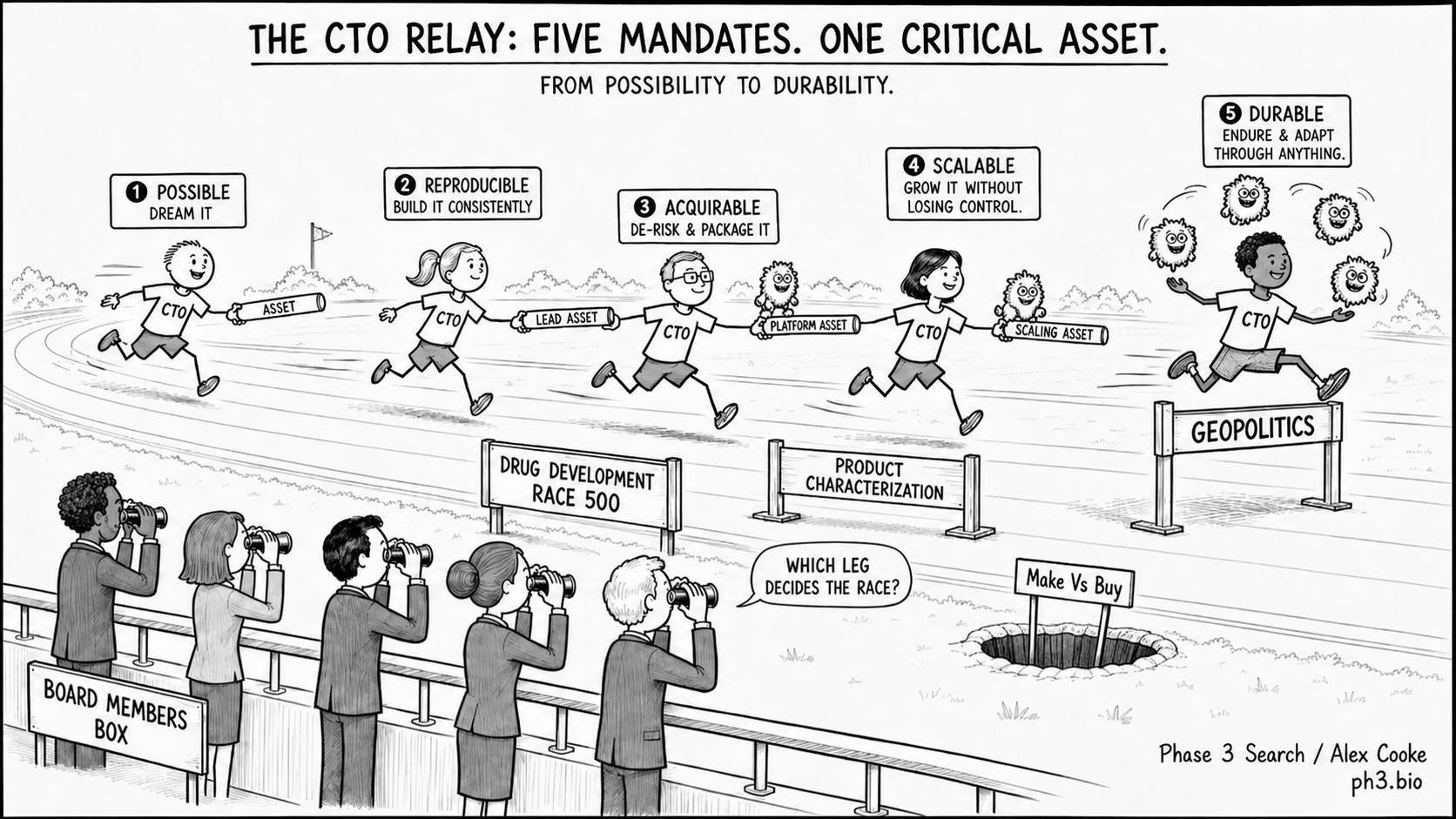
TL;DR: A biopharma company exists to get a medicine to a patient, and everything else, the valuation and the cap table, is how it funds that. The thing most likely to stop it is rarely the science: more than half of the FDA rejection letters made public since July 2025 cite manufacturing, and CMC is the single most common deficiency category (BioSpace / Jefferies, 2026; McCarthy & O'Boyle, Drug Discovery Today, 2026). That risk lives inside one job. The CTO Mandate Framework is how a board reads whether the person in that job fits the risk the company faces right now.
The point of all of this
Before the framework, a word on the north star that sits under every Phase 3 CMC article. I believe biopharma's primary objective is to get a medicine to a patient in time to make their life better.
So when a therapy that works is held back, a share price moves. So does a life. Someone stays sick, or gets sicker, and my hope is that by changing how we govern these companies, we lift an asset's chance of reaching launch in time for a patient to have a better life.
It is all of our responsibility to keep the patient as the prime directive, that way governance has a purpose. Forget it and most of what we do turns into a spreadsheet with feelings.
The scenario
A board is working through the org and the talent bench, and someone asks the obvious thing: "so, is CTO, are they good? Don't we need great?"
Fair question. It also spirals fast.
Great at what, and great for which stage? The technical leader who is exactly right before your IND can be wrong at commercial with nothing about them changed.
It is more that the work moved underneath them.
One role, five mandates
Call it CTO, Head of CMC, or CTOQ if you want the quality in the title; it is one job. And the job is really five demands running at once, and which one matters most shifts as the company moves.
Possible makes the science investable. Reproducible makes the process provable. Acquirable, or Investable, makes the company survive M&A and investor diligence. Scalable turns a bench process into a system that carries many programmes. Durable keeps supply standing when the world pushes back and throws up variables no one planned for.
All five are always live. The one that leads at any stage is the one whose failure can end the round in front of you, or the company itself.
Greatness has to become a system
Kobe Bryant said the most important thing is to inspire people to be great at whatever they do. This is also the arc of technical leadership in a sentence.
Early on, greatness can sit in one person. A gifted CTO holds the science and the process in their own head and carries a young company a long way on it. That works right until the company gets bigger than one head.
Then the size of that head becomes the ceiling. The work turns from being great to building something that stays great without you: the standard, the training, the paper trail that makes the next batch as good as your instinct when you are not in the room.
Add more programmes and sites, and the system has to grow with them.
Possible is greatness in a person. Durable is greatness in a system.
There is a long road between two extremes. At one end, the startup that moves fast and makes the call late night, over a team pizza. At the other, a forty-programme pipeline with the governance and the trade-off rules to survive almost anything. A system is what carries a company from the first to the second. Switch to it too soon and nothing moves as it dies in the clutches of bureaucracy. Cling to startup heroics too long and it buckles when the cult of personality can no longer hold the strain.
The five mandates are the road between the two, and the leader's real job is to get greatness off their own shoulders and into the firm before the complexity beats them to it.
The board's version, in money
A biotech's worth is a bet on getting an approvable product to a date, and the multiplier on that worth only climbs as the company moves from a product held up by key-man risk to one carried by a CMC and Quality system a diligence team can actually inspect.
Technical risk is the part of that bet boards read worst, because it stays out of sight until someone with less patience reprices it: the FDA at filing, a buyer in diligence, the IPO window, the next round. By then it is expensive and usually too late to fix. It is recoverable but the cost may be more than the business can bear.
So the useful question skips past whether your CTO is good and asks whether their focus, and the authority behind it, matches the risk that decides the company's next capital event.
Get the match right and you have bought time and optionality. Get it wrong and you'll find out at the worst possible moment, from the worst possible messenger, which is most likely a regulator or a buyer.
The radar, stage by stage
Think of the stages as a rotation. The lead mandate turns as the company moves.
Before your IND, Possible leads. Through Phase I and II, Reproducible takes over, because the heroics have to become systems. Into a filing or a sale, Acquirable runs it, because a diligence read sets your price. Across many programmes, Scalable leads. At commercial, Durable governs, because an inspection or a supply shock decides whether you keep the value you built.
At each stage one mandate dominates — the failure most likely to end the current capital event — while the others stay active. Watch the shape rotate from Possible (pre-IND) through to Durable (commercial). The right hire is calibrated to the dominant mandate now, and ready for the one next.
Drug development is a relay. The leg you are running changes as the company moves, and whoever flies on the second leg is not automatically who you want on the fourth. The radar just tells you which leg you are on, and which one you need to prepare for.
Why the profile shifts
Because the lead mandate changes, the profile under it changes too. Possible wants an evaluator, someone who looks at unproven science and calls what is investable and what is wishful. Reproducible and Acquirable start to build a system that holds knowledge and therefore value. Scalable and Durable want an enterprise builder who thinks in throughput and resilience. This is rarely the same person and is no criticism of anyone.
The founder-era technical leader, hired for Possible, is often still in the seat when the lead asset has moved to Reproducible or Acquirable, and nobody has flagged it, because the science is still moving. If the science needs a system or framework to reach its full potential, then changes may need to be made.
This is less about swapping leaders than about noticing when the emphasis has drifted; most good ones carry several of these at once. The framework points at the smallest fix that closes the gap, often just the emphasis or the authority rather than the person. And the best founders see it coming and build their own succession before the board has to.
Why it is a board question
When manufacturing and quality are the most-cited reason drugs get rejected in the FDA's recent letters, and buyers read your CMC to set the price, governing that risk is a board responsibility.
A board that cannot speak to it is governing its most common approval-blocking risk by hope, and hope is never enough.
Run the diagnostic first
The framework comes with a tool, and it is deliberately low-tech. Score each of the five mandates one to five for where the company actually is, and have every board member do it alone before anyone speaks.
Then lay your shape against the one your stage calls for. Where the two pull apart is your emphasis gap. Where board members scored the same mandate three points apart is your governance gap, and that argument is the whole point of the exercise.
Once the shape is on the table, four moves turn it into a decision. What the board does with it, identify:
- What is needed. Name the lead mandate. Before IND it is Possible, through Phase I and II Reproducible, into a filing or a sale Acquirable, across many programmes Scalable, at commercial Durable. If the room cannot agree which, you have your first finding.
- By when. Set the clock to the next capital event, not the fiscal year. Whatever mandate governs the raise or the readout or the filing in front of you is the one you are graded on.
- De-risk it. Two levers. Put the capability on the board, a member who has run CMC at that stage and can catch a deviation trend before it becomes a CRL. Or put it in the seat, a technical leader calibrated to the lead mandate with the authority to act. Authority and awareness can steer you round the worst.
- What phenotype. Early, you want the evaluator, and the tell is they kill their own ideas fast and cheap. Later, the enterprise builder, and the tell is they are already writing down what only they know. Hiring the second when you need the first, or keeping the first into the age of the second, is the costliest mismatch in this business.
The two questions every board must ask are these. Have we set our CTO up for success? Does their focus, and the authority behind it, match the mandate that owns our next capital event?
Answer it cleanly and you are governing technical risk well. Struggle with it and you have found the gap, and the gap closes, with a governance change or a different leader, in time for the round and for the patients on the far side of it.
Run the four moves on your own company before the coffee goes cold. If they come easily, you are in good shape. If they do not, you have found the gap, and I built a board calibration tool for exactly this read. Message me and I will send it over. If the gap turns out to be a leader you do not yet have, then that is the search that my team and I will help you run.
The prime directive for all of us is to make sure a medicine reaches the person waiting for it; everything else is secondary. Operational discipline is what keeps the mission from failing at the last mile, after the science is won and before the patient is reached.
Get technical leadership right and you protect valuation, exit, and the enterprise. You also protect the reason it exists.
If this is your discipline, let's talk.
Every engagement begins with a diagnostic — a structured read on the role and the company you are actually inheriting.
Start a diagnostic Our CTO & technical leadership practice →