
Is your board built for the round you just closed?
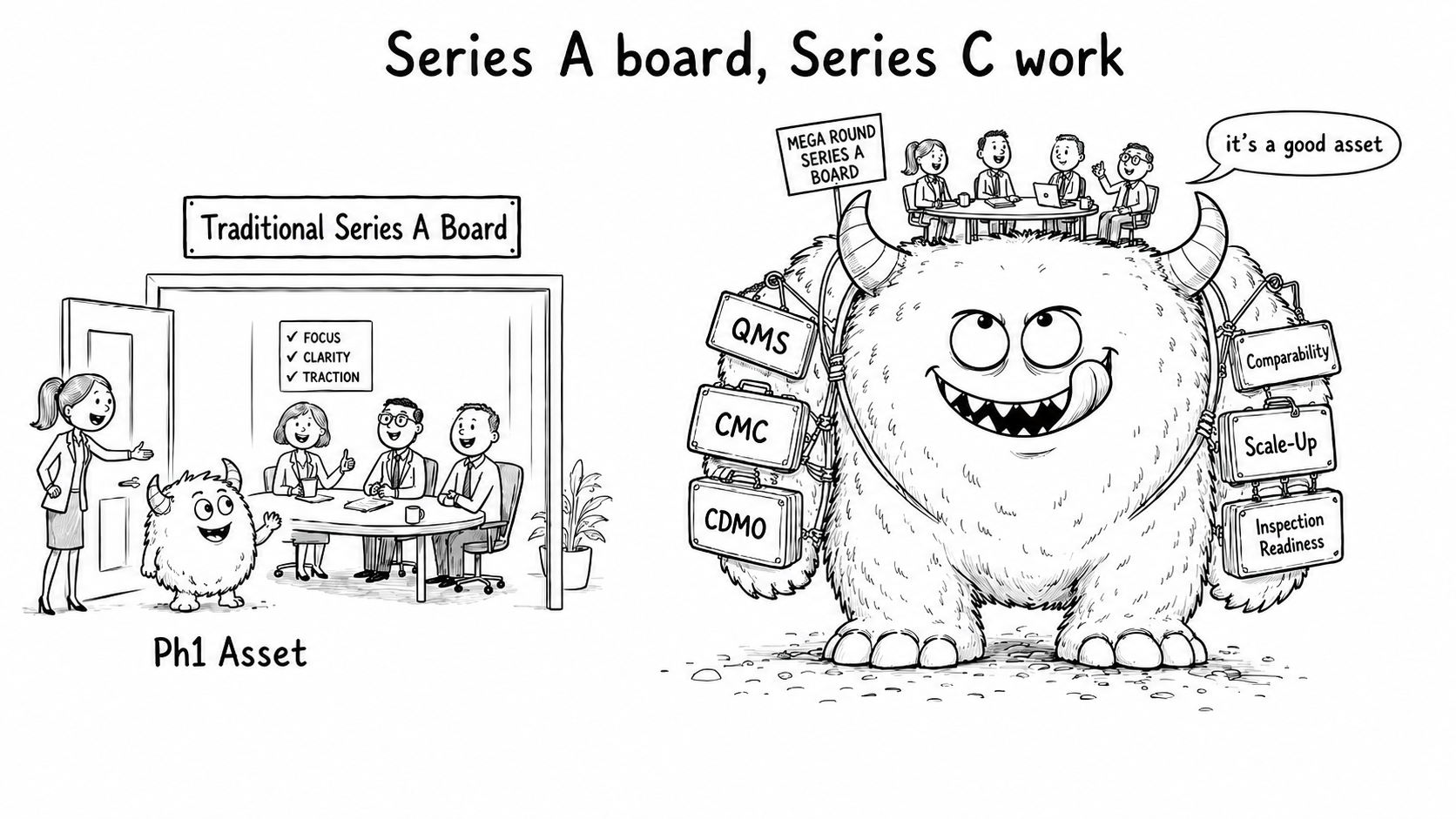
This is a little controversial, but when your board asks its questions this quarter, it's worth checking whose company they think they're overseeing.
TL;DR: Series A no longer means small, or early. Beeline Medicines closed a $426.3M Series A in H1 2026 behind a Bristol Myers Squibb-derived asset already in Phase 2. Crystalys Therapeutics launched with a $205M Series A to fund global Phase 3 trials. Treeline Biosciences added $200M to its Series A to move three programs into the clinic. In each case the round was labeled Series A while the company behind it was already running mature, sometimes clinical-stage, operations. The capital moved forward two rounds. The governance sitting on top of it usually didn't, and the questions a late-stage board asks, about CMC, manufacturing readiness, comparability, inspection-readiness, are rarely the ones a Series A board is built to ask. Those are CMC questions, and they are the reason a company raising at this scale increasingly needs a CMC voice in the room before they turn into problems.
A Series A used to buy about two years of runway and a proof-of-concept study. That was the deal.
It also bought a board sized for that deal: people whose job was to stress-test a hypothesis and decide, a milestone at a time, whether to keep funding it.
These days, a Series A increasingly buys something else entirely.
In April, Beeline Medicines emerged from stealth with $300M in Series A financing built around five immunology assets licensed in from Bristol Myers Squibb, backed by Bain Capital. By the end of June it had added another $126.3M, taking the round to $426.3M. The lead asset, afimetoran, was already in Phase 2 for lupus when the round closed. That is a clinical program with data behind it, capitalized at the round that is supposed to be asking whether the science works at all.
Crystalys Therapeutics did something similar in September 2025: a $205M Series A, co-led by Novo Holdings, SR One and Catalys Pacific, built to run global Phase 3 trials for dotinurad, a gout drug already approved in Japan, China, the Philippines and Thailand. Treeline Biosciences, backed by ARCH Venture Partners, KKR and GV, added $200M to its Series A the same month to push three programs into the clinic.
Three different companies. One shared fact: the round was labeled Series A, but the clinical activity behind it wasn't.
Why this is happening now
PitchBook's Ben Zercher put it plainly to BioSpace in July: many of this year's Series A and B "megarounds" are being raised by companies founded five or more years ago, running mature operations and, in some cases, clinical-stage programs already. The series label, he said, doesn't always capture the full picture.
Cooley partner Mike Nelson, in the same reporting, described the wider split. Early-stage financing, seed and Series A combined, is on pace for its lowest annual count since before the pandemic, even as later-stage rounds hit $4.5B across 51 deals in the first quarter, the highest Q1 figure in recent years.
Put those two facts side by side and you get the market this piece is actually about. Fewer companies are raising a true first round, and the ones that do are often not first-round companies at all: mature platforms and spinouts carrying in-licensed clinical assets, built for years before anyone opened a data room to outside money. The label on the round stopped describing what's inside it.
That's the setup. Here's the part boards miss.
A board is built for the money it expects
Investors gravitate toward what they know. A Series A investor's mandate is optionality: back the team and size the market, then stay close enough to kill the program early if the thesis breaks. A crossover or IPO investor's mandate is verification, confirming the record still holds up once a stranger, an acquirer, an inspector, a public-market analyst, reads it cold.
Those are different jobs, run against different failure modes, at different points in a company's life.
HSBC's Jon Norris described the old pattern to BioPharma Dive in 2023: crossover investors leading a Series A or B round specifically to hand a company "a big cash pile" ahead of an IPO attempt. That was deliberate, a crossover investor stepping into an early round on purpose, already thinking about the verification questions a public-market analyst would ask soon after.
Beeline, Crystalys and Treeline didn't raise crossover rounds. Bain Capital, Novo Holdings, SR One, Catalys Pacific, ARCH, KKR, GV, these are traditional venture and growth investors running the standard Series A optionality mandate. What's moved is what they're funding. Phase 2 and Phase 3 programs, the multi-asset clinical pushes that used to wait for a Series B or C, are now sitting inside a Series A led by investors whose mandate was never verification.
Now the clinical activity has moved forward two rounds. The board has not.
What a late-stage board asks that a Series A board often doesn't
If your company is running Phase 2 or 3 work with in-licensed or near-approved assets, or locking in a CDMO relationship, at the Series A stage, ask your board these questions honestly.
Who on this board has personally sat through a pre-approval inspection, and can tell you what an inspector actually looks for when they walk the floor?
Does anyone ask about comparability, whether the process making drug at clinical scale is provably the same process that will make it at commercial scale, or does that question get deferred until the CDMO contract comes up for renewal?
Who owns the standard for manufacturing readiness? Is that person in the boardroom, or three levels below it?
When the data room eventually opens, is anyone confident the story the company tells the market and the record that backs it up will still match under a stranger's second question?
A board built to evaluate a hypothesis is not automatically equipped to evaluate a manufacturing process, and there's no reason it should be. The people in the room did nothing wrong. The mismatch is between what the board was built to do and what the company is now doing under it. Nobody fails here because they stopped caring. Nobody updated the seating chart when the money started moving faster than the calendar did.
I know how this sounds, coming from a search firm that benefits when a board decides it needs a different voice in the room. I'll own that bias rather than pretend it isn't there. But the mismatch is real whether or not I'm the one naming it, and the cost of ignoring it lands on the asset, at the exact moment, diligence, inspection, the raise after this one, when it can least afford it.
Your Series A raised like a Series C. Your board is still a seed board.
A seed board asks whether the idea is worth funding. A Series C board asks whether the company can survive being read by a stranger, because a stranger is about to read it. When the balance sheet matures three rounds faster than the governance on top of it, the board is still meeting like it's reviewing a seed deck while the company two doors down is prepping a comparability protocol, and nobody in the room is asking the questions that stranger will ask first.
For the CEO, the gap is invisible until someone outside the company tests it, and by then it's already showing up in the financing terms. For the board member who joined at the seed stage, it looks different: you are now underwriting an inspection you have never personally sat through, and a manufacturing standard you have never had to own.
Nobody renegotiates board composition on the way to closing a term sheet. Which is exactly why it has to happen deliberately, on a normal Tuesday, months before anyone needs it to.
I looked at ten of these mega-rounds. One had a CMC voice on the board.
Of ten biotechs that raised nine-figure Series A rounds between 2024 and 2026, only one seated a director whose career was built in CMC, manufacturing or technical operations. On every other board, the discipline that owns manufacturing, comparability and inspection risk had no voice in the room where the company is governed.
So I stopped asserting it and went to count. I pulled ten companies that raised large Series A rounds in the current cycle, most of them funding in-licensed, already-clinical assets, and read their boards against one question: is anyone here from the part of the company an inspector actually visits? Almost everywhere, the answer was no.
| Company | Round | CMC voice on the board? |
|---|---|---|
| Xaira Therapeutics | $1B+* | No |
| Beeline Medicines | $426M Series A | No |
| Verdiva Bio | $410M Series A | No |
| Kailera Therapeutics | $400M Series A | No |
| Mirador Therapeutics | $400M Series A | Partly · a director who once ran a contract manufacturer, now a pharma CEO |
| Candid Therapeutics | $370M Series A | No |
| Metsera | $290M launch* | No |
| Crystalys Therapeutics | $205M Series A | No |
| Treeline Biosciences | $200M+ Series A | No |
| Alveus Therapeutics | $197M Series A | Yes · Carlo de Notaristefani |
The one board built the way this piece argues for belongs to Alveus, and it raised the smallest round on the list. Alveus put Carlo de Notaristefani on its board: he ran Technical Operations at Bristol Myers Squibb, was Executive Vice President of Operations at Teva, and was a lead advisor for manufacturing and supply chain at Operation Warp Speed. A $197M round made the governance choice the $400M rounds did not.
Method: ten biotechs that announced nine-figure launch or Series A financings in 2024–2026, boards read from company sites, launch releases and SEC filings as of July 2026. Eight were formally labeled Series A; Metsera ($290M launch, since acquired by Pfizer) and Xaira ($1B+ launch) were large launch financings not labeled Series A, marked with an asterisk. "Partly" for Mirador reflects a director with a real but dated contract-manufacturing pedigree whose current role is chief executive rather than technical operations. Company status has moved since these rounds: Candid Therapeutics has since been acquired by UCB (2026) and Kailera Therapeutics has since gone public; the boards analysed are those in place at the time of each Series A. Classifications are Phase 3 Search's, based on public disclosures.
The round doesn't set the phenotype. The work does.
A Series A technical leader is traditionally hired to prove the first two mandates of the CTO Mandate Framework: Possible, making the science real enough to invest behind, and Reproducible, making it run the same way twice. That is the phenotype an early round selects for, and it is the right one when the science is genuinely early.
A late-stage, in-licensed asset has already cleared that ground. The work in front of it is Reproducible, Acquirable and Scalable: holding the process under a stranger's diligence and building the machine that makes it at commercial scale. That is a different phenotype of leader, selected against a different set of failures. The phenotype a company needs is set by the work in front of it, not by the letter on the round. A Series A that bought Series C work needs the Series C phenotype, whatever the term sheet calls it.
This is where the missing board seat costs the most. When no one on the board has run technical operations, the technical leader has to educate up: explain to the room why comparability, or an inspection that is still theoretical, deserves money now. It is the hardest kind of persuasion, an argument for spending against a risk the audience cannot yet see, made by the one person in the building with no peer at board level to confirm it is real. A CMC voice on the board turns that lonely lecture into a conversation between equals. Its absence leaves the technical leader carrying a late-stage case into a room still built for an early-stage one.
What actually changes it
The fix is one addition to the board: someone whose job, explicitly, is to ask the late-stage questions early, before the company has a late-stage problem. Usually that's a CTO, a Head of CMC, or a board advisor who has already sat through a pre-approval inspection and already negotiated a comparability protocol.
There is a reason the voice a modern board most needs is a CMC voice. When capital arrived after the science was largely settled, CMC sat downstream: prove the molecule, then work out how to make it at scale. Now the money arrives while the hardest technical questions are still open, which makes CMC matter earlier, and matter more, than it did even a few years ago. CMC is the discipline built around the unknown you cannot yet see: the comparability break that only surfaces at scale, the process that will not transfer between sites, the facility that cannot pass an inspection no one has scheduled. A board underwriting late-stage technical risk needs that instinct in the room as a standing seat, someone whose job is to surface the failure mode while the clinical story is still the exciting part, rather than a consultant it calls in once something has already broken. That is the case for a CMC voice on the board, and I have made it in full in time for a CMC voice in the boardroom.
We built the CTO Mandate Framework for exactly this gap: what a technical leader is actually accountable for, stage by stage, and why the questions change even when the title doesn't. The Acquirable mandate covers the specific discipline of surviving a stranger's diligence, what a diligence team opens first, and it's worth reading before your board finds out the hard way.
Capital moves trust and authority around a boardroom long before it changes anyone's judgment, and if nobody manages that deliberately, the CEO ends up absorbing the gap personally, a trap I've written about in the CEO's capital problem. The same logic that says not all capital stays for the hard part, most of it doesn't, applies to board attention too. Enthusiasm is easy to raise. Staying at the table through a comparability deviation takes something else entirely.
Next step, concretely: pull your last board deck and time how many minutes went to clinical strategy against how many went to manufacturing readiness. If the answer embarrasses you, treat it as useful information. It just means the board hasn't caught up to the round yet. Ask your next board candidate, or your next senior technical hire, the inspection question directly. If they've never been in the room for one, they can still be a good hire. They just aren't the one who closes this gap. The full CTO Mandate Framework and our technical operations executive search practice are reasonable places to start deciding who is.
The round already told the market what stage you're at. Whether your board confirms that story, or contradicts it the first time a stranger reads the record, is still an open question at most of these companies. Better to close it before somebody else finds it open.
Questions this raises
Should a Series A biotech have a CMC or manufacturing expert on its board?
Increasingly, yes. When a Series A funds clinical-stage or in-licensed assets, the board is underwriting manufacturing, comparability and inspection risk that a traditional Series A board is not built to evaluate. A director who has run CMC or technical operations gives that risk a voice before it shows up in diligence.
How many biotech mega-round boards include a CMC or technical-operations director?
In a July 2026 Phase 3 Search review of ten biotechs that raised nine-figure Series A rounds in 2024 to 2026, only one (Alveus Therapeutics) had a director whose career was built in CMC, manufacturing or technical operations. On every other board, the discipline that owns manufacturing and inspection risk had no seat.
Who is Carlo de Notaristefani?
Carlo de Notaristefani is a pharmaceutical technical-operations executive who was President of Technical Operations at Bristol Myers Squibb and Executive Vice President of Operations at Teva, and served as a lead advisor for manufacturing and supply chain at Operation Warp Speed. He sits on the board of Alveus Therapeutics, one of the few biotech boards with a dedicated CMC voice.
Sources and notes
- Beeline Medicines closed a $300M Series A in April 2026 (five in-licensed immunology assets from Bristol Myers Squibb, backed by Bain Capital), adding $126.3M by June 30, 2026 for a total Series A of $426.3M; lead asset afimetoran was in Phase 2 for lupus at the time of the raise. Source: BioSpace, "5 largest VC rounds of H1 2026," July 8, 2026; BioSpace, "BMS makes a Beeline," April 15, 2026; GlobeNewswire, "Beeline Medicines Announces Upsized Series A of $426.3 Million," June 30, 2026.
- Crystalys Therapeutics launched with a $205M Series A financing (co-led by Novo Holdings, SR One and Catalys Pacific) to fund global Phase 3 trials of dotinurad, already approved in Japan, China, the Philippines and Thailand. Source: PR Newswire, "Crystalys Therapeutics Launches with $205M Series A Financing to Transform the Treatment of Gout," Sept. 30, 2025.
- Treeline Biosciences closed a $200M Series A extension in September 2025 (investors include ARCH Venture Partners, KKR and GV), bringing total funding since its 2021 founding to $1.1B, and initiated Phase 1 trials across three clinical programs. Source: FierceBiotech, "Treeline reaps $200M series A extension, plucks first 3 clinical candidates," September 2025.
- PitchBook senior analyst Ben Zercher: many 2026 Series A and B "megarounds" are being raised by companies founded five-plus years ago, with mature operations and, in some cases, clinical-stage programs; "the series label doesn't always capture the full picture." Cooley partner Mike Nelson: early-stage (seed and Series A) financing volume in H1 2026 was on pace for its lowest annual count since before the pandemic, even as later-stage rounds totaled $4.5B across 51 deals in Q1 2026, the highest Q1 value in recent years. Source: BioSpace, "5 largest VC rounds of H1 2026," Tristan Manalac, July 8, 2026.
- Historical framing of the crossover-investor mandate: crossover investors have historically led Series A or B rounds specifically to set a company up with, in HSBC managing director Jon Norris's words, "a big cash pile" ahead of an IPO attempt, a mandate distinct from a standard Series A venture mandate. Source: BioPharma Dive, "In a year with few biotech IPOs, 'crossover' financings are hard to find," Gwendolyn Wu, Aug. 16, 2023. Cited for the historical definition of the crossover mandate, not as a current-year statistic.
- Board composition norms by stage and the specific diligence questions a late-stage board asks (comparability, inspection-readiness, ownership of the manufacturing standard) reflect the author's operating view from the CMC, quality and technical-operations searches Phase 3 Search runs, not a cited survey.
- Board-composition review (Phase 3 Search, July 2026). Boards read from company sites, launch releases and SEC filings as of July 2026. Beeline Medicines: launch release (GlobeNewswire, April 15, 2026). Crystalys Therapeutics: launch release (PR Newswire, Sept. 30, 2025) and independent-director appointment (PR Newswire, Feb. 2026). Treeline Biosciences: company disclosures and the Standard BioTools merger filings (2026). Verdiva Bio: verdivabio.com and UK Companies House. Kailera Therapeutics: SEC Form 424B4 (2026). Mirador Therapeutics: miradortx.com; director Joseph C. Papa's manufacturing/CDMO pedigree (Cardinal Health Pharmaceutical Technologies & Services; Emergent BioSolutions): company releases. Candid Therapeutics: SEC Form S-4/A (2026). Metsera: SEC filings (Metsera acquired by Pfizer, Nov. 2025). Xaira Therapeutics: launch release (April 2024) and xaira.com. Alveus Therapeutics board, including Carlo de Notaristefani: alveustx.com; Series A of $160M (first close January 2026) upsized to $197M at final close in February 2026.
If this is your discipline, let's talk.
Every engagement begins with a diagnostic — a structured read on the role and the company you are actually inheriting.
Start a diagnostic Our CTO & technical leadership practice →